Marxism-Leninism: A political method for working-class emancipation and socialism in the 21st century
This resource for the SACP’s political education work brings together a range of materials on key topics, with quotes from and/or links to essential works by revolutionary thinkers and activists. These are arranged under the subjects listed in the contents menu, and will include information on current political education activities.This resource for the SACP’s political education work brings together a range of materials on key topics, with quotes from and/or links to essential works by revolutionary thinkers and activists. These are arranged under the subjects listed in the contents menu, and will include information on current political education activities.
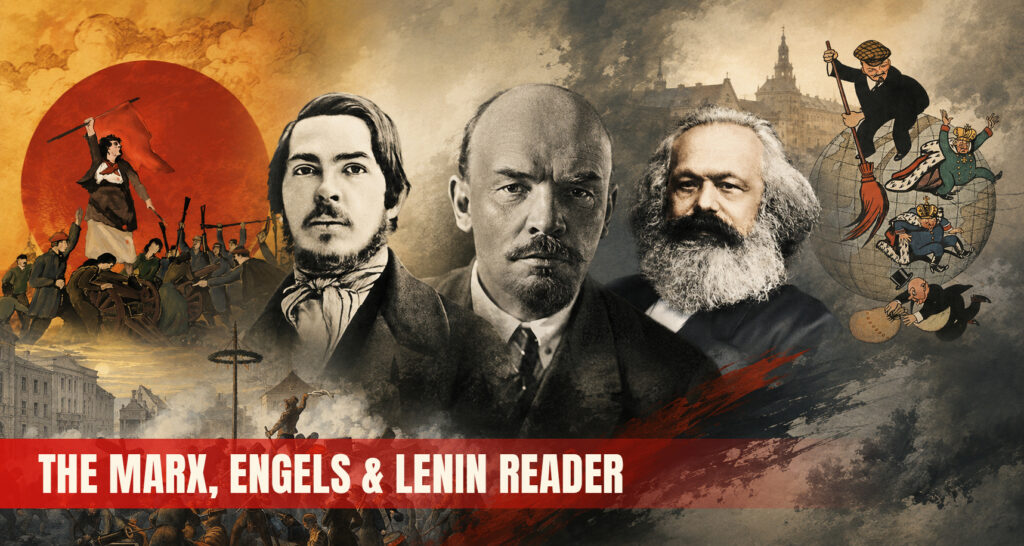
Marxism-Leninism is a revolutionary political tradition and method of social analysis that emerged from the works of Karl Marx, Friedrich Engels, and Vladimir Ilyich Lenin. It represents the theoretical and practical framework adopted by communist and workers’ parties across the world, particularly in the Global South — including the South African Communist Party (SACP) — as the guide to understanding society, organising the working class, and advancing the struggle for socialism.
The Marxist foundations
At the core of Marxism-Leninism is historical materialism — the scientific method for understanding society developed by Marx and Engels. Historical materialism holds that the economic base of society, the relations of production and the ownership of the means of production, ultimately determines its political, legal, and cultural structures. History, in this view, is driven by contradictions between the forces of production and the social relations within which they operate, expressed in the struggle between classes.
In The Communist Manifesto (1848), Marx and Engels argued that all history is the history of class struggle. Under capitalism, this struggle is concentrated between the bourgeoisie — the owners of capital — and the proletariat — the working class that sells its labour power. Through the concept of surplus value, developed at length in Capital (Volume I, 1867), Marx demonstrated that profit under capitalism derives from the unpaid labour extracted from workers, making exploitation not an accident but the foundation of the system.
Dialectical materialism — the philosophical method underpinning this analysis — teaches that reality is material, in constant motion, and driven forward by internal contradictions. Change is not smooth or gradual but proceeds through the sharpening and resolution of contradictions, giving Marxism its understanding of why revolutionary ruptures are possible and necessary.
Lenin’s contributions
Lenin developed Marxism in the era of imperialism and applied it to the practical tasks of revolutionary organisation. In Imperialism, the Highest Stage of Capitalism (1916), he analysed how capitalism in its monopoly phase exports capital, divides the world among competing powers, and intensifies the exploitation of colonised peoples. This analysis remains indispensable for understanding the global economy and the structures of dependency that shape countries in the Global South.
Lenin’s organisational contribution was equally decisive. Against currents that favoured a loose, broad movement, he argued in What Is to Be Done? (1902) for a party of professional revolutionaries — a vanguard party — capable of bringing socialist consciousness to the working class and leading it in disciplined, strategic action. This was not elitism but a recognition that spontaneous struggle, while vital, is insufficient without organised revolutionary leadership.
Equally important was Lenin’s theory of the state. In The State and Revolution (1917), drawing on Marx and Engels, Lenin argued that the capitalist state is not a neutral arbiter but an instrument of class rule. The working class cannot simply take over this state apparatus; it must smash it and replace it with a workers’ state — the dictatorship of the proletariat — as a transitional form on the road to a classless, stateless communist society.
Marxism-Leninism in the South African context
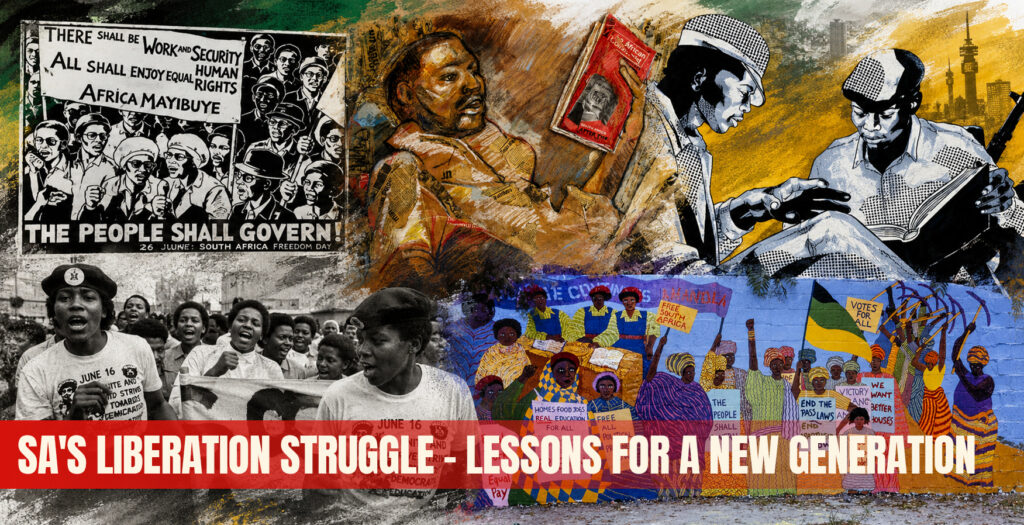
In South Africa, Marxism-Leninism has been the ideological framework of the SACP since its founding as the Communist Party of South Africa in 1921, making it one of the oldest communist parties on the African continent. The SACP has applied this framework to the specific conditions of South African capitalism — which developed through racial dispossession, colonial conquest, and apartheid — arriving at the theory of Colonialism of a Special Type (CST). CST analysed South Africa as a society in which national oppression and class exploitation were fused in a single system, requiring a two-phase process of national democratic revolution (NDR) and socialist transformation.
This analysis shaped the SACP’s strategic alliance with the African National Congress and the Congress of South African Trade Unions, forming the basis of the tripartite alliance that guided the liberation movement and continues to shape progressive politics in the democratic era.
A living method
Marxism-Leninism is not a fixed dogma but a living method — a set of analytical tools and organisational principles that must be applied creatively to concrete conditions. As Lenin insisted, there is no revolutionary movement without revolutionary theory. For working-class forces in South Africa and internationally, Marxism-Leninism remains the most powerful instrument available for understanding the world we live in and transforming it.
Continue Reading