Note: the links in this section lead to the full works that can be downloaded
The aim here is not to provide a narrative of the struggle in South Africa or a comprehensive rundown of material for political education. There is a lot of material on this already available on the Party’s website and elsewhere. This section can only provide an overview of the struggle to point out some useful sources for political education contained in the works of key struggle figures.
Contents
Foundations
Radicalisation and the turn to mass struggle
Armed struggle, underground organisation and exile
Women in struggle
Lessons for the present
The liberation struggle in South Africa was not a single event but a long, contested, and many-sided historical process — one that drew on international and indigenous traditions of resistance, developed a sophisticated theoretical framework, and forged organisational forms capable of sustaining struggle across generations of repression. For seasoned comrades, much of this history is lived experience. For young activists entering political life today, it is essential grounding as a living source of dialectical lessons for the struggles of the present.
Foundations
The African National Congress (ANC), founded in 1912, emerged from the first organised African response to the dispossession and humiliation of colonial rule consolidated by the Act of Union in 1910. The early ANC was shaped by a petitioning tradition that reflected the class character of its founding leadership — traditional leaders and educated professionals who believed, initially, that moral argument and legal appeal could move the colonial state. The limits of this approach were demonstrated repeatedly, most devastatingly the 1913 Land Act, which stripped African people of the right to own land across 87 per cent of South Africa’s territory. Pixley ka Isaka Seme, Sol Plaatje — whose Native Life in South Africa (1916) remains one of the most powerful documents of colonial dispossession ever written — and others of the founding generation built the organisational foundations even as the political horizon remained constrained.
The South African Communist Party (SACP), founded in 1921 as the Communist Party of South Africa, brought a new theoretical and organisational dimension to the liberation movement. The Party’s development of the theory of Colonialism of a Special Type in its 1962 programme — the understanding that South Africa represented a unique formation in which the coloniser and colonised lived within a single state, and in which national and class oppression were structurally fused — remains a contribution of lasting significance. It provided the framework for understanding why national liberation and socialist construction were not sequential stages but interpenetrating dimensions of a single revolutionary process, and it grounded the strategic centrality of the worker-led alliance between the SACP, the ANC, and what would become Cosatu.
Radicalisation and the turn to mass struggle
The 1940s marked a decisive radicalisation. The ANC Youth League, founded in 1944 and shaped by figures including Anton Lembede, Walter Sisulu, Oliver Tambo, and Nelson Mandela, injected a militant Africanism and a commitment to mass action that transformed the organisation’s political character. The Programme of Action adopted in 1949 — the year after the National Party’s electoral victory inaugurated the formal apartheid system — marked the turn from petition to mass struggle. The Defiance Campaign of 1952, in which volunteers deliberately courted arrest by defying apartheid laws, brought the Congress Alliance – comprising the ANC, South African Indian Congress, Coloured People’s Congress, South African Congress of Democrats and the South African Congress of Trade Unions – into a new relationship with the masses and demonstrated the potential of disciplined non-violent resistance.
The theoretical production of this period was remarkable. The magazine Liberation, published from 1953, became a crucial site of Marxist and liberation analysis. Cde Nelson Mandela’s contributions — including his foundational 1956 article In Our Lifetime, which argued for the inseparability of national and social liberation — demonstrated a thinker developing his theoretical framework in direct engagement with political practice.
Cde Govan Mbeki’s writings on the Reserves and bantustans are rigorous, empirically grounded analyses of the specific conditions of rural African life under apartheid, laying bare the economic function of the reserve system as a mechanism for producing cheap migrant labour for the mines and farms. These themes Mbeki developed more fully in South Africa: The Peasants’ Revolt (1964), a major historical study of peasant struggles in Pondoland and Sekhukhuneland. Much of the book deals with the revolutionary potential of the poor peasants and agricultural workers. Between 1956 and 1960 revolts broke out in many parts of the countryside. Notably, in Zeerust, Sekhukhuniland, Zululand, and finally in Pondoland, the confrontation took the form of a sustained armed conflict.
Cde Ruth First’s journalism and scholarship extended this analytical tradition, connecting the specifics of South African conditions to the broader frameworks of Marxist political economy.
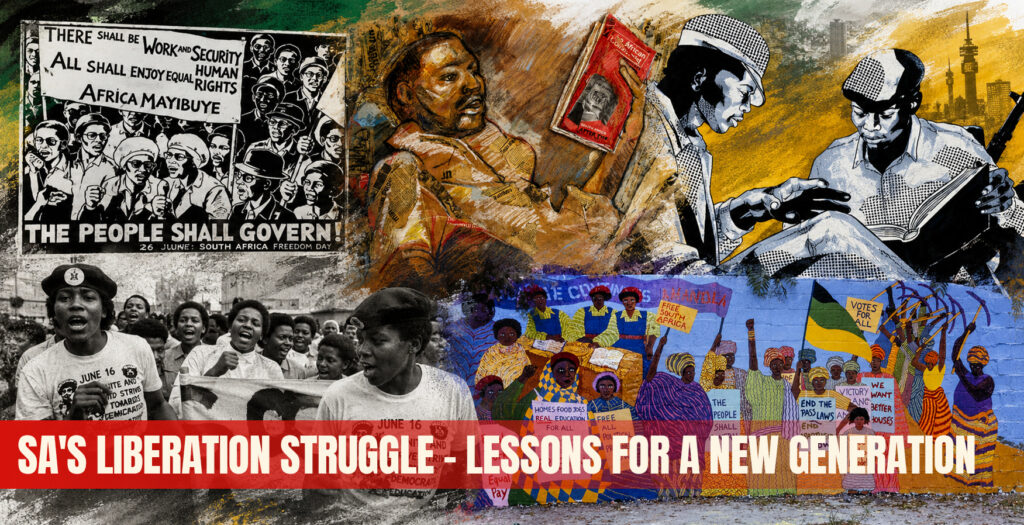
The Freedom Charter, adopted by the Congress of the People at Kliptown in 1955, represented the Congress Alliance’s most comprehensive programmatic statement — a vision of a non-racial, democratic South Africa in which the wealth of the country would be shared among all who lived in it. Its drafting process, drawing submissions of ordinary people across the country collected by a volunteer force of 50,000 activists, was itself a model of mass democratic participation. The Charter’s vision of social and economic transformation remains, more than seven decades later, an unfinished programme — and its unfulfilled promises speak directly to the political tasks of the present.
Armed struggle, underground organisation and exile
The Sharpeville massacre of March 1960 and the subsequent banning of the ANC and SACP forced the movement into a new phase. The formation of Umkhonto we Sizwe (MK) in 1961, the Rivonia Trial, and the imprisonment of Mandela and other leaders on Robben Island did not destroy the movement — they transformed it. The island became, famously, a site of political education as much as of punishment, with prisoners studying, debating, and developing their theoretical understanding under conditions of extraordinary difficulty. Cde Mandela’s No Easy Walk to Freedom and the later Long Walk to Freedom are essential documents of this period (though not available online), as is the I am Prepared to Die statement from the Rivonia Trial — one of the great political speeches in the history of the liberation movements.
Cde Oliver Tambo’s three decades leading the ANC in exile produced a body of speeches and statements — collected in O.R Tambo – speeches, articles, letters — that constitute an underutilised theoretical resource. Cde Tambo was not primarily a writer in the conventional sense, but his speeches demonstrate a thinker of considerable depth, consistently insisting on the international dimensions of the South African struggle and on the centrality of the working class to the liberation movement. His development of the ANC’s international solidarity networks, and his management of the complex internal debates of the movement in exile, make him one of the most important strategic thinkers the South African liberation movement produced.
Cde Chris Hani’s written and spoken contributions are essential for understanding the SACP’s development in the late apartheid and early transition period. His combination of military experience, mass popularity, and theoretical rigour made him unique in the leadership of the liberation movement, and his assassination in April 1993 — at the hands of a right-wing conspiracy — deprived the movement of one of its most capable and least compromised leaders at the critical moment of transition. His speeches and interviews, many available through the SACP and online archives, require careful study, particularly his insistence that the liberation movement must remain rooted in and accountable to the working class and the poor.
Aside from The Peasants’ Revolt (1964), Cde Govan Mbeki’s other writings remain an important source. His body of written work spans several decades and several genres, from political journalism to autobiography to social analysis. In 1938, he published a series of eight articles that subsequently appeared in the form of a short book, Transkei in the Making. It challenged the view that rural Africans were backward because of their own cultural conservatism, arguing that the Transkei’s poverty was the product of colonial conquest and laws that drove young men to work in cities and mines.
Learning from Robben Island (1991), published after Mbeki’s release following twenty-four years of imprisonment, reflects on the experience of political imprisonment and political education under the most extreme conditions. Robben Island had been a site of sustained intellectual and political work among the prisoners — a “university” in the movement’s own self-description — and Mbeki’s account of this experience highlights the relationship between theory and practice, between the maintenance of political clarity under conditions of brutal repression, and the cultivation of the cadre qualities that would be needed for the struggle ahead.
The Struggle for Liberation in South Africa: A Short History provides a concise and accessible account of the liberation movement for a broad readership.
Sunset at Midday (1996), his late autobiographical work, offered a more personal and reflective account of his political life and of the transition period. For Cde Mbeki, the liberation struggle proved to have been “a war without absolute winners,” one in which African nationalism and Afrikaner nationalism “had fought to a draw.” But as he went on to remind his readers, “revolutions, even modest ones, are made not in our dreams but in concrete historical circumstances. What we have, although far from perfect, is a starting point.”
Cde Jabulani Nobleman “Mzala” Nxumalo, Gatsha Buthelezi: Chief with a Double Agenda (1988), is a political analysis of Mangosuthu Buthelezi and the Inkatha movement — their relationship to the apartheid state, their role in the violent suppression of the liberation movement in KwaZulu-Natal, and the ideological underpinnings of Buthelezi’s reactionary politics. The book remains an important work of Marxist class analysis, situating Buthelezi and Inkatha within the broader framework of the apartheid state’s strategy of creating and sustaining collaborative African elites as a bulwark against the liberation movement — a strategy with deep roots in colonial indirect rule and clear parallels with the Bantustan project analysed by Govan Mbeki.
Beyond this major work, Cde Mzala contributed numerous theoretical articles to the African Communist and other movement publications, which can be searched from the Party’s website or in the archive of the journal at https://www.marxists.org/subject/africa/periodicals/african-communist/index.htm.
Women in struggle
The role of women throughout this history demands particular emphasis – see also the section on women in struggle. The 1956 Women’s March to the Union Buildings, led by Cdes Lillian Ngoyi, Helen Joseph, Rahima Moosa, and Sophie Williams, against the extension of pass laws to women, was a defining moment of mass resistance. The Federation of South African Women’s 1954 Women’s Charter anticipated demands that would take decades to be formally recognised. In the political underground, MK, in exile, and on Robben Island, women sustained the movement — as organisers, couriers, political prisoners, and theorists. Ruth First, Dora Tamana, Lilian Ngoyi, Albertina Sisulu, Dorothy Nyembe, Helen Joseph, Thandi Modise, Ela Gandhi, Dulcie September — assassinated by a regime agent in Paris in 1988 — and many others made a huge contribution and some paid the ultimate price. Hilda Bernstein’s For Their Triumphs and Their Tears – Women in Apartheid South Africa is an important account of this history. The collected testimonies in the South African Democracy Education Trust volumes contain essential primary source material, as does South Africa History Online’s History of Women’s Struggle in South Africa
Other key written sources for study
The literature of the South African liberation struggle and its theoretical foundations is vast, and what follows is necessarily selective.
The SACP’s own theoretical and programmatic documents remain indispensable starting points. The 1962 programme, The Road to South African Freedom, which elaborated the theory of Colonialism of a Special Type in its most systematic form, is essential reading. It should be read alongside the later programme The Path to Power (1989), which updated the CST framework and addressed the conditions of the insurrectionary moment. Both are available on the SACP website.
Joe Slovo’s contributions represent some of the most rigorous and Marxist writing produced by the South African liberation movement. No Middle Road (1976) is essential for understanding the regional context of South African liberation and the strategic relationship between the liberation movements of the subcontinent. His later Has Socialism Failed? (1990) was one of the very few contributions by a communist leader anywhere in the world that engaged honestly and unflinchingly with the failures and crimes of actually existing socialism, while maintaining a principled commitment to the socialist project. Its intellectual honesty and political courage make it required reading not only as a historical document but as a model of the kind of critical self-examination that Marxist theory demands. The South African Working Class and the National Democratic Revolution (1988) is equally important for understanding the SACP’s strategic thinking on the relationship between class and national struggles.
Cde Ruth First’s work spans journalism, scholarship, and political analysis. The compilation Selected Writings contains important analyses, in particular the article From the Freedom Charter to Armed Struggle. Her book The Barrel of a Gun (1970) analysed the wave of military coups across post-independence Africa.
Cde Harold Wolpe’s theoretical work — particularly his 1972 article Capitalism and Cheap Labour Power in South Africa — was a landmark contribution that shaped a generation of South African Marxist scholarship. Samir Amin’s work on unequal development and Giovanni Arrighi’s analyses of labour and capital in southern Africa provide essential regional frameworks.
Other sections of the SACP website carry an extensive archive of party documents, theoretical journals including the African Communist, and historical materials that constitute a valuable resource for political education at all levels. The South African History Archive, the Historical Papers collection at the University of the Witwatersrand, and the O’Malley Archive — a remarkable oral history collection covering the transition period — are all accessible online and provide important primary source material. YCLSA and other young activists, in particular, should be encouraged to engage with these digital archives, which make available a depth of historical and theoretical material that previous generations could only access with considerable effort and often at considerable risk.
Beyond the specifically South African literature, several broader Marxist texts have been particularly important. Lenin’s What is to be Done? and Imperialism, the Highest Stage of Capitalism are foundational. Gramsci’s Prison Notebooks — particularly the concepts of hegemony, the war of position, and the organic intellectual — have been influential in shaping thinking about the cultural and ideological dimensions of struggle in the post-apartheid conjuncture.
Lessons for the present
The liberation struggle teaches, above all, that revolutionary advance is not linear. The movement faced repeated setbacks — banning, imprisonment, exile, assassination, internal divisions — and each time reconstituted itself at a higher level of organisation and theoretical clarity that also progressed in non-linear directions. The unbanning of the ANC and SACP in 1990 and the democratic breakthrough of 1994 represented a genuine historic victory, won through the combination of mass struggle, armed resistance, underground organisation, international solidarity, and sustained theoretical work.
But as the SACP has consistently argued, 1994 was a beginning, not an end. The structural power of racial capitalism was not dismantled by the democratic transition. The NDR remains unfinished. The working class and the poor — whose sacrifices made liberation possible — have not yet inherited the full fruits of that liberation.
It is in this context that the SACP’s current strategic initiatives must be understood — not as departures from the liberation tradition, but as its creative continuation. The People’s Red Caravan takes political education and organisational work directly into working-class and poor communities, reviving the tradition of cadre formation and mass engagement that characterised the movement at its best. The decision to contest local government elections represents an assertion that the SACP must be accountable to and rooted in the working class and poor communities it seeks to lead — that the party cannot be only a theoretical vanguard but must demonstrate its programme in practice. The Conference of the Left and the broader project of left unity respond to the fragmentation of progressive forces that has weakened the capacity of the working class to advance its interests in the post-apartheid conjuncture.
Activists encountering this history for the first time should understand it not as a completed story but as an ongoing process involving the relationship between theory and practice, between national and class struggle, between the immediate demands of the poor and the longer horizon of socialist transformation.