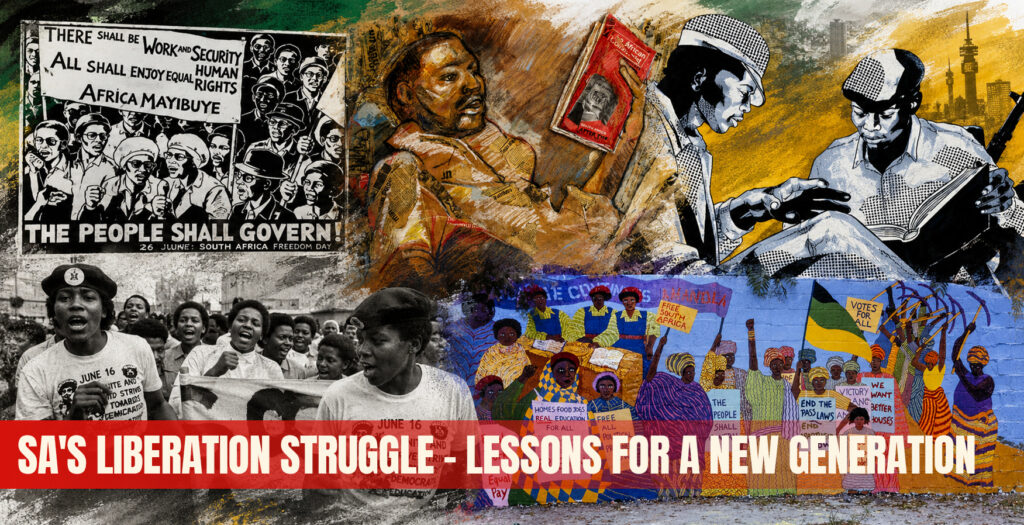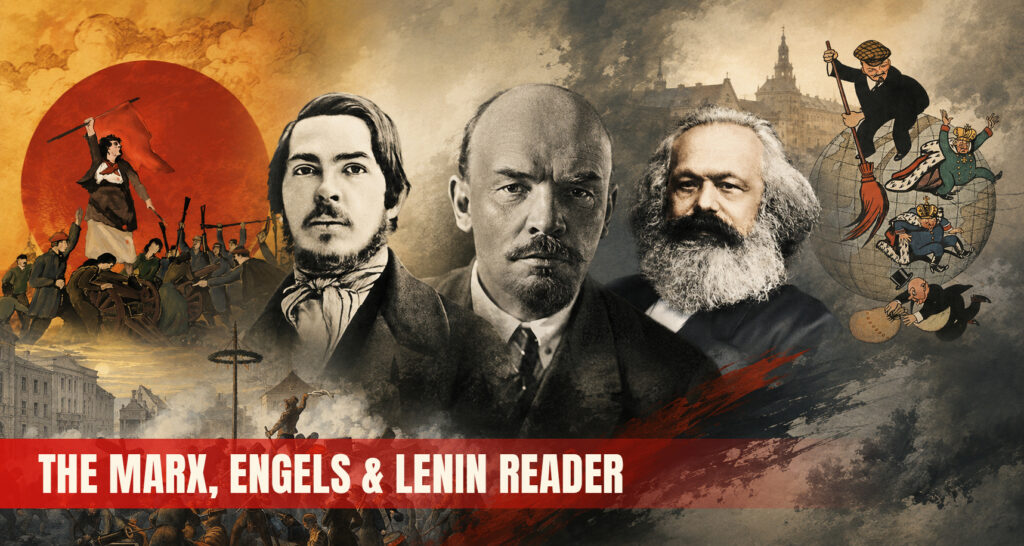
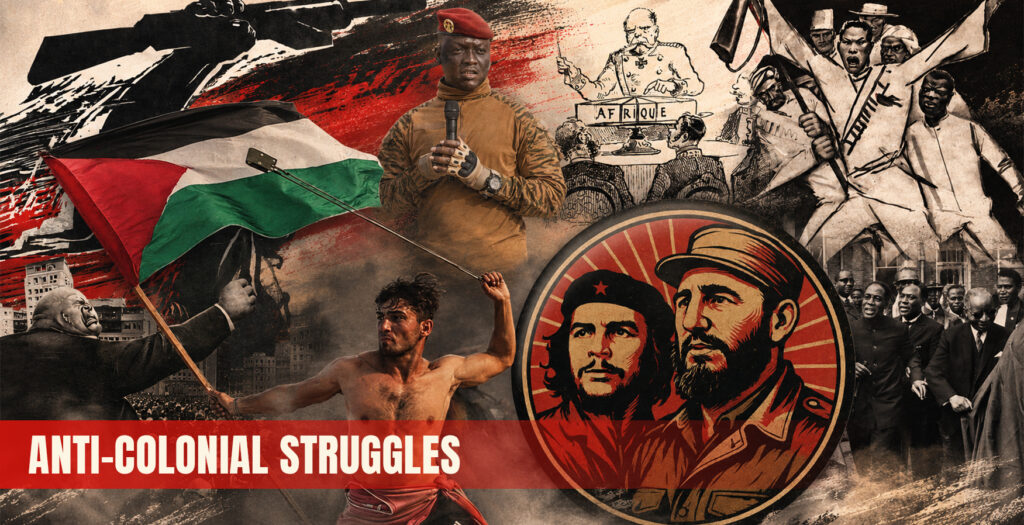
Note: the links in this section lead to the full works that can be downloaded
Contents
The Marxist foundations: imperialism and colonial exploitation
Theorising colonialism from the colonial world
Neocolonialism: domination in another form
Congo: imperialism’s blueprint
West Africa: expelling the neocolonial order
Southern Africa: liberation and its limits
Latin America and the Caribbean: revolution, dependency, and permanent struggle
East Asia and the Chinese Revolution: Marxism in the colonial periphery
Korea: the war against re-colonisation
Vietnam: beating the imperial beast
India: mass struggle, non-cooperation, and the limits of nationalism
Postcolonial theory and its debates
Decolonisation today: concept and struggle
Unfinished struggles
Marxist-Leninist praxis (theory and practice) in the 20th and 21st centuries has both developed and been shaped by approaches to the question of colonialism. The meeting of Marxism and the colonial world was more than just an expansion of socialist ideas into new areas. It was a life-changing meeting that made the theory much deeper, harder, and in some ways completely new. Understanding colonialism — its origins, its mechanisms, its persistence in new forms, and the many-sided struggle against it — remains essential to political education.
The Marxist foundations: imperialism and colonial exploitation
Marx himself laid the important groundwork. His analysis of primitive accumulation in Capital — the violent dispossession of peasants and communities that created the conditions for capitalist development — was always implicitly a theory of colonialism, despite its European focus.
His writings on Ireland, India, and the American Civil War grapple with the relationship between colonial exploitation and the development of capitalism at its centre. Engels too engaged with colonial questions, though both thinkers were understandably constrained by the Eurocentric assumptions of their time — a limitation that later Marxists from the colonial world would critically address.
It was Lenin who made the decisive theoretical leap. His 1916 work Imperialism, the Highest Stage of Capitalism argued that colonialism was not an aberration or a moral failing of particular European powers — it was a structural necessity of capitalism in its monopoly phase.
The export of capital, the carving up of the world among competing imperial powers, and the super-exploitation of colonised peoples were not incidental to capitalism’s development but integral to it.
This insight had profound implications: it meant that the struggle for national liberation in the colonial world was not separate from the struggle against capitalism, but was one of its most important fronts. Lenin’s theoretical framework placed the anti-colonial movements of Asia, Africa, and Latin America at the heart of the world revolutionary process. This was further developed by the work of the Communist International.
Theorising colonialism from the colonial world
The most powerful elaborations of anti-colonial theory came from thinkers who had themselves lived under colonial rule — and whose intellectual contributions both drew on and went beyond the Marxist tradition they inherited.
Aimé Césaire, the Martinican poet and communist, delivered one of the most devastating critiques of colonialism in his 1950 Discourse on Colonialism. Césaire argued that colonialism did not merely exploit the colonised — it brutalised and dehumanised the coloniser as well, corroding European “civilisation” from within. His concept of négritude — the affirmation of African cultural identity and dignity against the cultural violence of colonialism — was a necessary moment of resistance.
Frantz Fanon, born in Martinique and shaped by the Algerian revolution, took the analysis further and in some respects in a different direction. In The Wretched of the Earth (1961), Fanon argued that colonialism was a total system — economic, political, cultural, and psychological. The violence of colonialism was not just a side effect; it was an essential part of the process. It had a big effect on the way the colonised people thought, making them feel disconnected and distant – alienated – from others. Fanon said that this led to a kind of mental confusion, or subjectivity, that could only be fixed by fighting for freedom. Fanon believed that ordinary people, the rural strata in particular, were key to overthrowing colonial rule. He also warned that a new ruling class made up of a business elite might take over and block fundamental change. In the years that followed, this turned out to be true in many African countries.
Amílcar Cabral, the leader of the liberation movement in Guinea-Bissau and Cape Verde, combined theoretical brilliance with extraordinary practical capacity. His concept of the “return to the source” (see Identity and Dignity in the Context of the National Liberation Struggle in Return to the Source: Selected Speeches by Amílcar Cabral 1973) — the revolutionary intelligentsia reconnecting with the culture and life of the peasantry — and his insistence on culture as a site of resistance and liberation, anticipated many of the concerns of later postcolonial thought. Cabral’s analysis of the class forces within anti-colonial movements, and his warnings about the “weakness of the petty bourgeoisie” as a leading class in post-independence states, remain among the most penetrating contributions to anti-colonial Marxist theory.
Walter Rodney, the Guyanese historian and activist, provided in How Europe Underdeveloped Africa (1972) what remains one of the most rigorous and accessible analyses of the economic mechanisms of colonial exploitation. Rodney demonstrated systematically how the colonial relationship did not just fail to develop Africa (which was never its purpose) — it actively underdeveloped it, draining resources, distorting economies, and structuring dependency in ways that would persist long after formal independence.
Neocolonialism: domination in another form
Formal independence, achieved across much of Africa and Asia in the 1950s and 1960s, did not end colonial exploitation. It changed its form without eliminating its content. Kwame Nkrumah, Ghana’s first president and one of the leading Pan-Africanist thinkers, gave this new reality its defining name and analysis in Neo-Colonialism: The Last Stage of Imperialism (1965). Neocolonialism, Nkrumah argued, operated through the formal independence of states combined with their continued economic subordination — through debt, trade relations, foreign investment, currency arrangements, and where necessary, military intervention. The state was nominally sovereign; the economy remained controlled from outside. Political power had been transferred; economic power had not.
Nkrumah’s analysis has only deepened in relevance. The structural adjustment programmes imposed by the International Monetary Fund and the World Bank on African states from the 1980s onwards were a textbook application of neocolonial power — dismantling public services, opening markets to foreign capital, disciplining states that stepped outside the parameters of the Washington Consensus. The debt crisis across the Global South remains a mechanism of neocolonial control, transferring wealth from the poorest countries to the richest financial institutions with a relentlessness that no amount of development aid comes close to reversing.
Congo: imperialism’s blueprint
The overthrow and assassination of Patrice Lumumba in 1960-61 deserves treatment as a distinct subject in political education, not only because of its devastating consequences for the Congo and the broader African liberation project, but because it functions as a kind of blueprint — a concentrated illustration of how imperialist power operates when its fundamental interests are threatened by genuine popular sovereignty.
Lumumba came to power through the Congo’s first democratic elections in May 1960, leading his Mouvement National Congolais to the largest share of the vote. From the outset, he faced a set of overlapping imperial interests determined to prevent genuine Congolese sovereignty. Belgium, unwilling to relinquish control over the immensely profitable Katanga mining region, supported the immediate secession of Katanga under Moïse Tshombe — a separatist project sustained by Belgian officers, European mercenaries, and the mining giant Union Minière. The US, consumed by Cold War anxiety at the prospect of a non-aligned or potentially socialist-oriented government controlling the Congo’s uranium — the same uranium that had fuelled the Manhattan Project — placed Lumumba under immediate surveillance and moved rapidly to plan his removal. The CIA station chief in Leopoldville cabled Washington that Lumumba was a dangerous figure who needed to be “eliminated,” and plans for his assassination were authorised at the highest levels of the Eisenhower administration.
Lumumba’s appeals to the United Nations for assistance against the Belgian-backed Katanga secession were met with a UN operation that systematically undermined rather than supported his government — a pattern of UN complicity in imperial interests that would recur across later decades. Abandoned by the imperialist West, Lumumba turned to the Soviet Union for logistical support, which provided the pretext his enemies needed to intensify their efforts. In September 1960, with CIA support and the connivance of UN officials, Colonel Joseph Mobutu carried out his first coup, placing Lumumba under house arrest. Lumumba escaped, was recaptured, and in January 1961 was transferred to Katanga, where he was tortured and executed by a firing squad in the presence of Belgian officers. His body was dissolved in acid to prevent it from becoming a site of commemoration.
The theoretical lessons are as important as the historical facts. Lumumba’s elimination illustrates the precise mechanism Nkrumah would theorise four years later in Neo-Colonialism: that formal political independence means nothing if the forces of imperial capital retain the capacity and the will to destroy any government that genuinely threatens their interests. It illustrates the role of international institutions — the UN, in this case — as instruments that can serve imperial interests behind the language of neutrality and peacekeeping. It illustrates the function of comprador elites — Mobutu, Tshombe — as the indispensable local agents of neocolonial power. And it illustrates the speed and ruthlessness with which imperialism moves when it perceives a genuine threat to its structural interests, regardless of democratic legitimacy or international law.
West Africa: expelling the neocolonial order
Important recent expressions of anti-neocolonial struggle in Africa have come from West Africa, where a wave of political ruptures — in Mali, Burkina Faso, Niger, and Guinea — has brought to power governments explicitly committed to ending the structures of French neocolonial domination. Whatever the complex and varied character of these transitions, and whatever debates exist on the left about their class struggle credentials, they represent an authentic popular revolt against a neocolonial order that has visibly failed the majority of people in the region — and they demand serious analytical attention rather than dismissal.
France’s relationship with its former African colonies has long been the most nakedly neocolonial of any former imperial power’s post-independence arrangements. The CFA franc — a currency originally created by France in 1945 and still used across fourteen African countries — has functioned as a structural mechanism of dependency, tying monetary policy to French and European interests and requiring member states to deposit a significant portion of their foreign exchange reserves with the French treasury. Alongside this monetary architecture, France maintained a network of military bases across the Sahel and West Africa, intervened militarily in its former colonies on numerous occasions to protect friendly governments and economic interests, and cultivated a class of political elites — the Françafrique network — whose loyalty to Paris frequently outweighed their accountability to their own populations. Nkrumah’s diagnosis of neocolonialism could have been written with precisely this arrangement in mind.
It is in this context that the figure of Thomas Sankara assumes its full significance — both historically and for the current moment. Sankara led Burkina Faso from 1983 until his assassination in 1987, in a revolutionary government of remarkable energy and ambition. Drawing explicitly on Marxist-Leninist and Pan-Africanist traditions, Sankara launched programmes of mass vaccination, literacy, land redistribution, women’s emancipation, and environmental restoration that achieved concrete improvements in living conditions in a remarkably short time. He renamed the country from Upper Volta to Burkina Faso — “the land of upright people” — as an assertion of dignity and self-determination. He refused to pay the colonial debt, arguing memorably that it had been contracted against the interests of the African people and that its repayment was a continuation of colonial tribute. He built a non-aligned foreign policy, refused IMF structural adjustment, and was an outspoken voice for African unity and sovereignty on the continental and world stage. His assassination — widely attributed to the machinations of neighbouring Côte d’Ivoire’s Felix Houphouët-Boigny, with French complicity strongly suspected — cut short one of the most genuine attempts at socialist construction in post-independence Africa.
Sankara’s legacy has returned with force in the current conjuncture. In Burkina Faso, Captain Ibrahim Traoré, who came to power in 2022, has explicitly invoked Sankara’s memory and programme, moving to expel French military forces, diversify international partnerships, and reassert sovereignty over the country’s natural resources. Similar dynamics have unfolded in Mali under the transitional government, and in Niger following the 2023 coup that removed a government seen as a French client. The expulsion of French ambassadors and military contingents, the renegotiation of resource agreements, and the explicit rejection of the CFA franc architecture by several of these governments — alongside a turn towards Russia, China and other partners — represent a decisive, if contested, shift in the region’s political alignment.
The governments in question are not, in most cases, led by communist or workers’ parties. But the underlying popular sentiment — the rejection of the neocolonial order that has delivered poverty, insecurity, and humiliation across generations — is entirely legitimate, and the structural analysis that animates the best of these movements draws directly on the Marxist-Leninist anti-colonial tradition.
Southern Africa: liberation and its limits
Southern Africa occupies a distinctive place in the history of anti-colonial struggle. The region was among the last in Africa to achieve formal liberation, with the Portuguese colonial wars ending only in 1974-75, Zimbabwe’s independence in 1980, Namibia’s in 1990, and South Africa’s democratic breakthrough in 1994.
The liberation movements of the region — the ANC and SACP in South Africa, SWAPO in Namibia, ZANU and ZAPU in Zimbabwe, FRELIMO in Mozambique, MPLA in Angola — were shaped by a longer and more sustained experience of armed and political struggle than movements elsewhere on the continent, and developed correspondingly richer theoretical and organisational traditions.
The SACP played a central role in theorising the relationship between national liberation and socialist construction in the South African context, through the concept (developed from positions taken at the Communist International) of the National Democratic Revolution — originally understood not as a stage separate from socialism, but as the specific path through which the South African working class and its allies would advance towards it. The NDR’s insistence on the interlinked character of national oppression and class exploitation — the theory of colonialism of a special type — was a distinctive theoretical contribution that drew on and extended the broader anti-colonial Marxist tradition.
The experience of post-independence southern Africa also illustrated Fanon’s warnings with painful clarity. In Mozambique and Angola, for instance, FRELIMO and MPLA led genuine socialist projects that were systematically destroyed by South African destabilisation and CIA-backed insurgencies — a reminder that neocolonial power does not rely on economics alone, but reaches for military violence when its interests demand it.
Ruth First’s analytical work on southern Africa — on Mozambique, on migrant labour, on the structures of racial capitalism — remains essential reading in this context (see Selected Writings). Her insistence on rigorous structural analysis, combined with her commitment to the liberation of the whole person and the whole society, exemplifies the best of the Marxist-feminist anti-colonial tradition.
Latin America and the Caribbean: revolution, dependency, and permanent struggle
Latin America and the Caribbean occupy a special place in the history of anti-colonial struggle. The region experienced the first wave of formal decolonisation in the early 19th century, as Spanish and Portuguese colonial rule was overthrown across most of the continent between the 1810s and the 1820s. Yet formal independence did not bring genuine liberation. What followed was not decolonisation in any meaningful sense, but the substitution of European colonial domination with a new form of dependency — first under British economic hegemony, and then, decisively, under that of the United States.
The Caribbean had already produced one of history’s most profound anti-colonial revolutions. The Haitian Revolution of 1791-1804 — the only successful slave revolution in history, which defeated Napoleon’s armies and established the first Black republic in the world — stands as a foundational moment in the global history of liberation. C.L.R. James, the Trinidadian Marxist historian, rescued this history for the revolutionary tradition in his masterwork The Black Jacobins (1938), demonstrating how the enslaved people of Saint-Domingue had acted as a revolutionary class in their own right, anticipating and in some respects surpassing the radicalism of the French Revolution itself. This was both a work of history and a political intervention — written in the shadow of rising fascism and the unfinished business of colonial liberation, it insisted that the Black populations of the colonial world were not objects of history but its subjects.
The Cuban Revolution of 1959 marked a decisive turning point for the entire region and for the global anti-colonial movement. Under the leadership of Fidel Castro and the July 26th Movement, and with the indispensable theoretical and practical contribution of Fidel and Ernesto Che Guevara Cuba demonstrated that socialist revolution was possible in the Americas — and that it could survive in the face of sustained imperialist hostility. Guevara’s theory of the foco — the idea that a small revolutionary nucleus could create the conditions for broader insurrection — is developed in his work Guerrilla Warfare, and was later explored further by Régis Debray in works such as Revolution in the Revolution?
The most important theoretical contribution to emerge from Latin America in this period was dependency theory, developed by thinkers including André Gunder Frank, Ruy Mauro Marini, and Theotônio dos Santos, and drawing also on the earlier structuralist economics of Raúl Prebisch and the UN Economic Commission for Latin America. Dependency theorists argued that underdevelopment in Latin America was not a stage on the way to development — it was the product of the region’s specific insertion into the capitalist world system. (See e.g. Dialogues on Development, Volume 1 On Dependency)
The development of the centre required the underdevelopment of the periphery. Marini’s concept of super-exploitation — the intensification of labour exploitation in dependent economies to compensate for their disadvantaged position in world trade — provided a rigorous account of how imperialism operated through apparently market-based mechanisms. These insights ran parallel to and in dialogue with Rodney’s analysis of Africa, and together they constituted a major advance in Marxist political economy.
The late 2oth and early 21st centuries brought new expressions of anti-colonial and anti-imperialist struggle across the region — from the Zapatista uprising in Mexico in 1994, to the Bolivarian Revolution in Venezuela under Hugo Chávez, to the progressive governments of Bolivia, Ecuador, Brazil, and Nicaragua. These movements varied considerably in their theoretical frameworks and practical achievements, but together they constituted what became known as the “Pink Tide” — a regional turn to the left that challenged US hegemony and put questions of resource sovereignty, indigenous rights, and social redistribution back at the centre of political life. The ferocity of the imperialist and oligarchic backlash against these governments — through coups, sanctions, lawfare and destabilisation — confirmed Nkrumah’s analysis of neocolonial power with depressing regularity.
East Asia and the Chinese Revolution: Marxism in the colonial periphery
The Chinese Revolution of 1949 brought a quarter of humanity out of colonial and semi-colonial subjugation, and that produced one of the most significant adaptations of Marxist-Leninist theory to conditions outside Europe.
China’s encounter with colonialism was distinctive. Unlike Africa or much of Asia, China was never formally colonised by a single imperial power. Instead, from the mid-19th century onwards, it was subjected to semi-colonial domination — its sovereignty systematically undermined through unequal treaties, foreign concessions, extraterritorial privileges, and military humiliation, at the hands of Britain, France, Japan, Russia, and the United States in succession. The Opium Wars, the carving up of China into spheres of influence, and Japan’s brutal invasion and occupation from the 1930s onwards, constituted a sustained assault on Chinese sovereignty and dignity that shaped the entire political and intellectual landscape within which the Chinese Communist Party developed.
Mao Zedong’s theoretical contributions must be understood in this context. Mao’s development of the mass line — the method of synthesising the ideas of the masses, concentrating them through Marxist analysis, and returning them to the masses as a guide for action — was a response to the specific challenge of making revolution in a vast, predominantly peasant society with a weak and geographically concentrated industrial working class. His theory of the “bloc of four classes” — the proletariat, the peasantry, the petty bourgeoisie, and the national bourgeoisie — as the social foundation of the New Democratic Revolution adapted Lenin’s theory of the anti-colonial united front to Chinese conditions. His analysis of contradiction, developed in essays such as On Contradiction and On Practice, represented a significant elaboration of Marxist dialectical method, insisting on the specificity of contradictions and the importance of distinguishing principal from secondary contradictions in any concrete situation — an analytical tool of enduring value for communist parties operating in complex social formations.
The Chinese Revolution’s victory in 1949, achieved after decades of an extraordinarily difficult armed struggle against both Japanese imperialism and the US-backed Kuomintang, demonstrated that Marxist-Leninist theory could be creatively applied to conditions very different from those of Russia — and that the peasantry, properly organised and led, could be a revolutionary force of the first order. Its influence on liberation movements across Africa, Asia, and Latin America was enormous, offering both an inspiring example and a set of theoretical and practical tools adapted to the realities of the colonial periphery.
The relationship between the Chinese Revolution and the broader anti-colonial movement was not without its tensions and contradictions — the Sino-Soviet split of the early 1960s introduced a damaging fracture into the international communist movement, with consequences felt in liberation movements across southern Africa and elsewhere. But the core contribution — that Marxism-Leninism could be and must be creatively applied to specific national and historical conditions, that there is no single template for revolution, and that the struggles of colonised peoples are a central rather than peripheral front of the world revolutionary process — remains a lasting and indispensable insight.
Korea and Vietnam deserve special attention in any account of anti-colonial struggle in East Asia.
Korea: the war against re-colonisation
Though it is too often framed exclusively within Cold War narratives, the Korean War of 1950-53 holds a significant place in the history of anti-colonial struggle. Korea endured brutal Japanese colonial rule from 1910 to 1945, and the post-war division of the peninsula along the 38th parallel, imposed by the United States and the Soviet Union without the consent of the Korean people, was itself a colonial act. It denied the Korean people the right to determine their own national destiny. When the war broke out in 1950, it was widely perceived across the global South as a battle against the reimposition of foreign domination over an Asian nation that had only recently escaped the yoke of colonialism. China’s intervention alongside the Korean forces carried enormous symbolic weight: newly liberated itself, the People’s Republic demonstrated that Asian nations would resist Western military power on their own continent. The war’s outcome — preserving the division but thwarting an attempt at total military conquest — resonated powerfully with liberation movements across Africa and Asia, providing evidence that imperial military power was not invincible.
Vietnam: beating the imperial beast
The Vietnamese struggle against French colonialism and then US military intervention — sustained over three decades of sacrifice, and culminating in the defeat of the most powerful military force in the world in 1975 — was one of the great anti-colonial victories of the twentieth century. Ho Chi Minh, who combined the Vietnamese national liberation struggle with a rigorous Marxist-Leninist formation, characterised the best of the anti-colonial communist tradition (see the Ho Chi Minh Reference Archive). The Vietnamese victory reverberated across southern Africa, demonstrating to liberation movements — including the ANC and SACP — that a militarily weaker force, with political clarity, popular support, and revolutionary determination, could defeat a technologically superior imperial power.
India: mass struggle, non-cooperation, and the limits of nationalism
India’s struggle against British colonial rule was one of the longest, most complex, and most influential anti-colonial movements in history — and its impact extended far beyond the subcontinent. For the African National Congress in particular, the Indian independence movement offered both inspiration and practical lessons, shaped by the direct presence of a significant Indian community in South Africa whose own experience of racial oppression created organic links between the two struggles.
The Indian National Congress (INC), founded in 1885, evolved over decades from a petitioning organisation into a mass movement capable of challenging British imperialism. The transformation was inseparable from the figure of Mohandas Gandhi, whose development of satyagraha — non-violent resistance, or truth-force — as a political method was first elaborated not in India but in South Africa, where Gandhi organised the Indian community’s resistance to discriminatory legislation between 1893 and 1914. Gandhi’s South African years left a mixed legacy. His campaigns built important organisational precedents and introduced the method of non-violent mass resistance, visible later in the massive 1952 Defiance Campaign. But they also reflected the racist attitudes of the time, with Gandhi dismissive of African claims and concerned primarily with the status of Indians.
Jawaharlal Nehru brought a more explicitly socialist and internationalist framework to the independence movement, situating India’s struggle within the broader global context of anti-imperialism and aligning the post-independence Indian state with the Non-Aligned Movement. Nehru’s vision of a developmental state, pursuing industrialisation and social progress, influenced a generation of post-independence African leaders. B.R. Ambedkar’s challenge to the independence movement’s limitations — his insistence that national liberation that left the caste system intact was not genuine liberation for the Dalit masses — raised questions about the relationship between the national question and class struggle (see Mr Gandhi and the Emancipation of the Untouchables).
The Indian Communist Party, founded in 1920, radicalised key sections of the independence movement by linking India’s anti-colonial struggle to the international communist movement. Its contributions to the trade union movement, to peasant organising, and to the theoretical development of Marxist analysis of Indian conditions were substantial.
For the ANC and the SACP, the Indian connection was important. The Natal Indian Congress, revitalised in the 1940s under the leadership of figures including CPSA leaders Yusuf Dadoo and Monty Naicker, became a crucial component of the emerging Congress Alliance.
Postcolonial theory and its debates
From the 1980s onwards, a body of thought broadly described as postcolonial theory — associated with scholars such as Edward Said, Homi Bhabha, Gayatri Spivak, and others — emerged primarily in western academia and posed important questions about knowledge, representation, and the cultural dimensions of colonial power. Said’s Orientalism (1978) demonstrated how Western knowledge production had constructed the “Orient” (Western Asia) as its inferior “other”, providing ideological justification for colonial domination. Spivak’s question — “Can the subaltern speak?” — raised profound issues about whose voices and experiences are centred in political and intellectual life.
These contributions have real value, but they also carry limitations that Marxists have rightly identified. The turn towards discourse, culture, and representation in much postcolonial theory has sometimes come at the cost of attention to political economy — to the material structures of exploitation and accumulation that continue to shape the lives of formerly colonised peoples – as well as to the practice of struggle. A critical engagement with postcolonial theory, drawing on its insights while grounding them in a materialist analysis of power and class, is essential.
Decolonisation today: concept and struggle
The language of decolonisation has returned with force in recent years, particularly in South Africa following the Rhodes Must Fall and Fees Must Fall movements of 2015-2016. These movements raised important and legitimate demands — for the transformation of universities, for the decolonisation of curricula, for the end of institutional cultures that reproduce colonial hierarchies. They have drawn attention to the extent to which formal political liberation had not been matched by the decolonisation of knowledge, culture, and institutional life.
From an SACP standpoint, this renewed focus on decolonisation is to be welcomed — but it must be grounded in a rigorous understanding of what decolonisation actually requires. Thinkers such as Ndlovu-Gatsheni have made important contributions to theorising coloniality in the African context — the persistence of colonial power structures in the post-independence order. But decolonisation cannot be reduced to a cultural or discursive project. As Fanon and Cabral both insisted, genuine decolonisation requires the transformation of economic structures — the redistribution of land and wealth, the dismantling of monopoly capital, and the building of a developmental state capable of serving the interests of the working class and the poor.
In this sense, the decolonisation agenda and the socialist agenda are not in tension — they are, at their deepest level, the same agenda. The struggle to decolonise South Africa’s economy, to break the structural power of the minerals-energy complex, to achieve genuine land reform, to build an education system that serves the many rather than the few — these are also anti-colonial and socialist tasks. The SACP’s programme of socialist construction is, in this light, the most consistent and thoroughgoing expression of the decolonisation project.
Unfinished struggles
Two key areas of ongoing anti-colonial and anti-imperialist struggle have still to be mentioned: Palestine and Western Sahara.
Palestine is the most visible and contested site of current colonial dispossession in the world today. The establishment of the Israeli state in 1948 — the Nakba, the catastrophe, in which more than 700,000 Palestinians were expelled from their homes and lands — was not a consequence of war so much as its purpose: the violent clearing of an indigenous population to make way for a settler colonial project backed by the retreating British empire and subsequently by the United States as the dominant imperial power.
The decades since have seen the consolidation and deepening of this project — through the occupation of the West Bank and Gaza following the 1967 war, the systematic expansion of illegal settlements, the siege of Gaza, and the construction of an apartheid architecture of walls, checkpoints, separate roads, and differential legal systems that numerous human rights organisations and scholars, including Israeli ones, have described in precisely those terms.
The assault on Gaza from October 2023 onwards has brought the colonial reality of Palestine to the attention of a new global generation with an urgency that no amount of Zionist-inspired propaganda can obscure. For the SACP and the South African liberation movement, solidarity with Palestine has been grounded in the recognition of a structural parallel between the apartheid system the South African movement fought and dismantled, and the system of racial-colonial domination under which Palestinians continue to live.
South Africa’s historic case before the International Court of Justice, accusing Israel of genocide in Gaza, represents the most significant multilateral legal action arising from this solidarity, and a moment of profound historical resonance. For written sources, Edward Said’s The Question of Palestine (1979) and Orientalism (1978, linked above) are essential to understanding the colonial and cultural dimensions of the Palestinian question. Rashid Khalidi’s The Hundred Years’ War on Palestine (2020) provides the most rigorous recent historical account, situating the Palestinian struggle explicitly within the framework of settler colonialism. Ilan Pappé’s The Ethnic Cleansing of Palestine (2006) documents the Nakba with meticulous scholarly care. For an analysis of Israel’s apartheid policy, see the UN report Israel’s discriminatory administration of the occupied West Bank, including East Jerusalem. Noura Erakat’s Justice for Some (2019) examines how international law has been selectively applied to Palestine’s detriment — and how it might yet be mobilised in its defence.
Western Sahara is the last formally recognised colonial territory on the African continent — a status acknowledged by the United Nations, which lists it as a Non-Self-Governing Territory, and yet one that remains unresolved due to imperialist interference.
The territory was a Spanish colony until 1975, when Spain’s withdrawal — negotiated in the dying days of the Franco regime and under heavy Moroccan and Mauritanian pressure — resulted not in decolonisation but in the immediate occupation of the territory by Morocco, which has administered most of it ever since. The indigenous Sahrawi people, represented by the Polisario Front and its government in exile, the Sahrawi Arab Democratic Republic, have resisted this occupation through armed struggle, diplomacy, and the sustained organisation of a refugee population living in camps near Tindouf in Algeria for more than four decades.
A UN-brokered ceasefire in 1991 was accompanied by a promise of a referendum on self-determination that Morocco has consistently blocked, calculating — correctly, thus far — that it can rely on the support of France and, more recently, the United States to prevent any binding resolution. The Trump administration’s 2020 decision to recognise Moroccan sovereignty over Western Sahara — as part of the Abraham Accords normalisation process — was a nakedly transactional act that subordinated the self-determination rights of the Sahrawi people to geopolitical horse-trading, and represented a serious blow to the UN framework for resolving the dispute.
The African Union recognises the SADR as a full member state, and the SACP and ANC have consistently supported Sahrawi self-determination. The case of Western Sahara shows how the formal architecture of international law and UN resolutions on self-determination can be rendered hollow by the exercise of imperialist power politics — a lesson of direct relevance to the Palestinian question and to the broader analysis of neocolonialism.
For political education work, one of the best analyses of Western Sahara is the 2026 study by the Tricontinental Institute for Social Research Fifty Years of Moroccan Occupation: Renewing the Pan-African Struggle Against Imperialism. This draws on Lenin’s definition of imperialism as the division of the world among great powers for the purpose of extracting super profits, and analyses how Spain withdrew formally but retained economic interests, while the United States and France took over as arms suppliers and diplomatic cover, positioning Morocco as “the subcontractor of empire.”
Then and now
The history of fighting against colonial rule is still very much alive. Its insights are relevant to the conditions of southern Africa and the world today. Ideas are rooted in material reality: Lenin’s ideas about imperialism, Fanon’s ideas about the psychology of liberation, Cabral’s ideas about culture and resistance, Rodney’s ideas about the political economy of underdevelopment, Nkrumah’s ideas about neocolonialism and contemporary debates on decolonisation all help us to understand the world as it is and to change it. Political education in the SACP tradition engages seriously with this inheritance — not as a museum of revolutionary ideas or a view that theory is dry and incomprehensible, but as a set of living, practical and analytical tools. The structures of exploitation have not been dismantled. The struggle continues, and theory wedded to revolutionary practice as praxis remains indispensable.