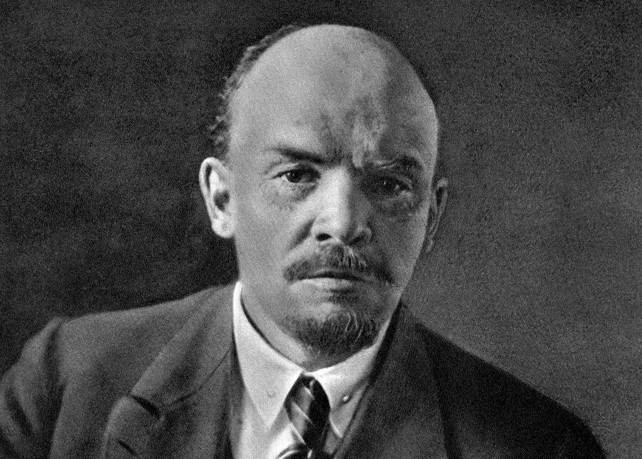
Lenin
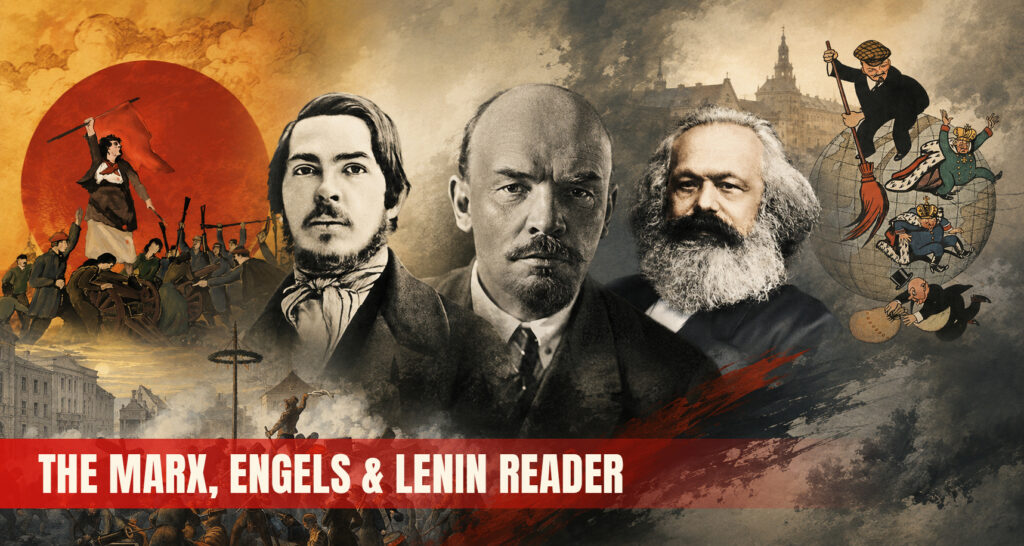
Vladimir Ilyich Lenin (1870–1924)
Vladimir Ilyich Lenin was a Russian revolutionary, theorist, and the principal leader of the Bolshevik Revolution of October 1917 — the first successful socialist revolution in history. Born in Simbirsk to a middle-class family, Lenin became a revolutionary following the execution of his brother by the Tsarist state. His theoretical contributions transformed and extended Marxism in several decisive respects: his theory of the vanguard party, developed in What is to be Done? (1902); his analysis of imperialism as capitalism’s highest stage; and his practical leadership of a revolutionary movement under conditions of repression, war, and political crisis. Lenin led the Soviet state until his death in 1924, leaving a body of theoretical and practical work that has guided communist parties across the world ever since and remains essential in developing new revolutionary theory and practice.
Lenin was above all a practitioner of Marxist method: his theoretical writings are often inseparable from the political problems they were written to resolve, but they contain much that we can use today.
These extracts are organised under nine thematic headings. It is intended as a companion to the Marx and Engels study plan. Lenin presupposed familiarity with their central works — above all Capital, the Communist Manifesto, and The Civil War in France, and continually refers to Marx and Engels’ writing in his own work, which is why it is good to begin with the material from Marx and Engels before proceeding to Lenin.
CONTENTS
- Marxist method, philosophyand dialectics
Three influences Marx used
Idealism in materialist disguise
Dialectics
- The Party and revolutionary organisation
The importance of theory
Spontaneity versus care in theoretical and organisational work
Political education
Economism versus political struggle and working-class consciousness
Political work among all classes
Party organisation
On compromise
Party principle and discipline
Work in reactionary trade unions
Bourgeois parliaments
Against opportunism and “Left” doctrinairism
- Imperialism and Global Capitalism
Concentration of production and monopolies
Banks and their new role
Finance capital and the financial oligarchy
Export of capital
Division of the world among capitalist associations
Division of the world among the great powers
Imperialism as a special stage of capitalism
Parasitism and decay of capitalism, and effects on working-class movements
Critique of imperialism
The place of imperialism in history
- The state, revolution and democracy
The site of class antagonisms
Lessons of the Paris Commune
From capitalism to communism
- The national question and internationalism
Two types of nationalism
Not national culture but the international culture of democracy and the worldwide working-class movement
Tasks of the Communist International
- Agrarian question and land
Ownership or “socialisation” after land nationalisation?
- Strategy, tactics and conjuncture
The 1905 and February 1917 revolutions
Towards revolutionary government
- Socialist construction
What’s needed to assure victory?
The special stage of the revolution
The role of trade unions
The role of youth leagues
The situation of women
The New Economic Policy and state capitalism
Sharpening the state apparatus to modernise the country
The special stage of the revolution
- Marxist method, philosophyand dialectics
Lenin’s writings on Marx and philosophy were produced in direct response to theoretical crises within the Marxist movement — above all the attempt to revise the materialist foundations of Marxism in the direction of Machist empirio-criticism, a form of idealism. The result is a body of work that demonstrates Lenin’s understanding that philosophical clarity and political effectiveness are inseparable.
The Three Sources and Three Component Parts of Marxism (1913)
Lenin
https://www.marxists.org/archive/lenin/works/1913/mar/x01.htm
Lenin identifies the three intellectual traditions from which Marxism drew and synthesised: German classical philosophy, English political economy, and French socialism.
Three influences Marx used
I
[…] Marx and Engels defended philosophical materialism in the most determined manner and repeatedly explained how profoundly erroneous is every deviation from this basis. Their views are most clearly and fully expounded in the works of Engels, Ludwig Feuerbach and Anti-Dühring, which, like the Communist Manifesto, are handbooks for every class-conscious worker.
But Marx did not stop at eighteenth-century materialism: he developed philosophy to a higher level, he enriched it with the achievements of German classical philosophy, especially of Hegel’s system, which in its turn had led to the materialism of Feuerbach. The main achievement was dialectics, i.e., the doctrine of development in its fullest, deepest and most comprehensive form, the doctrine of the relativity of the human knowledge that provides us with a reflection of eternally developing matter. The latest discoveries of natural science—radium, electrons, the transmutation of elements—have been a remarkable confirmation of Marx’s dialectical materialism despite the teachings of the bourgeois philosophers with their “new” reversions to old and decadent idealism.
Marx deepened and developed philosophical materialism to the full, and extended the cognition of nature to include the cognition of human society. His historical materialism was a great achievement in scientific thinking. The chaos and arbitrariness that had previously reigned in views on history and politics were replaced by a strikingly integral and harmonious scientific theory, which shows how, in consequence of the growth of productive forces, out of one system of social life another and higher system develops—how capitalism, for instance, grows out of feudalism.
Just as man’s knowledge reflects nature (i.e., developing matter), which exists independently of him, so man’s social knowledge (i.e., his various views and doctrines—philosophical, religious, political and so forth) reflects the economic system of society. Political institutions are a superstructure on the economic foundation. We see, for example, that the various political forms of the modern European states serve to strengthen the domination of the bourgeoisie over the proletariat.
Marx’s philosophy is a consummate philosophical materialism which has provided mankind, and especially the working class, with powerful instruments of knowledge.
II
Having recognised that the economic system is the foundation on which the political superstructure is erected, Marx devoted his greatest attention to the study of this economic system. Marx’s principal work, Capital, is devoted to a study of the economic system of modern, i.e., capitalist, society.
Classical political economy, before Marx, evolved in England, the most developed of the capitalist countries. Adam Smith and David Ricardo, by their investigations of the economic system, laid the foundations of the labour theory of value. Marx continued their work; he provided a proof of the theory and developed it consistently. He showed that the value of every commodity is determined by the quantity of socially necessary labour time spent on its production.
Where the bourgeois economists saw a relation between things (the exchange of one commodity for another) Marx revealed a relation between people. The exchange of commodities expresses the connection between individual producers through the market. Money signifies that the connection is becoming closer and closer, inseparably uniting the entire economic life of the individual producers into one whole. Capital signifies a further development of this connection: man’s labour-power becomes a commodity. The wage-worker sells his labour-power to the owner of land, factories and instruments of labour. The worker spends one part of the day covering the cost of maintaining himself and his family (wages), while the other part of the day he works without remuneration, creating for the capitalist surplus-value, the source of profit, the source of the wealth of the capitalist class.
The doctrine of surplus-value is the cornerstone of Marx’s economic theory.
Capital, created by the labour of the worker, crushes the worker, ruining small proprietors and creating an army of unemployed. In industry, the victory of large-scale production is immediately apparent, but the same phenomenon is also to be observed in agriculture, where the superiority of large-scale capitalist agriculture is enhanced, the use of machinery increases and the peasant economy, trapped by money-capital, declines and falls into ruin under the burden of its backward technique. The decline of small-scale production assumes different forms in agriculture, but the decline itself is an indisputable fact.
By destroying small-scale production, capital leads to an increase in productivity of labour and to the creation of a monopoly position for the associations of big capitalists. Production itself becomes more and more social—hundreds of thousands and millions of workers become bound together in a regular economic organism—but the product of this collective labour is appropriated by a handful of capitalists. Anarchy of production, crises, the furious chase after markets and the insecurity of existence of the mass of the population are intensified.
By increasing the dependence of the workers on capital, the capitalist system creates the great power of united labour. […]
III
When feudalism was overthrown and “free” capitalist society appeared in the world, it at once became apparent that this freedom meant a new system of oppression and exploitation of the working people. Various socialist doctrines immediately emerged as a reflection of and protest against this oppression. Early socialism, however, was utopian socialism. It criticised capitalist society, it condemned and damned it, it dreamed of its destruction, it had visions of a better order and endeavoured to convince the rich of the immorality of exploitation.
But utopian socialism could not indicate the real solution. It could not explain the real nature of wage-slavery under capitalism, it could not reveal the laws of capitalist development, or show what social force is capable of becoming the creator of a new society.
Meanwhile, the stormy revolutions which everywhere in Europe, and especially in France, accompanied the fall of feudalism, of serfdom, more and more clearly revealed the struggle of classes as the basis and the driving force of all development.
Not a single victory of political freedom over the feudal class was won except against desperate resistance. Not a single capitalist country evolved on a more or less free and democratic basis except by a life-and-death struggle between the various classes of capitalist society.
The genius of Marx lies in his having been the first to deduce from this the lesson world history teaches and to apply that lesson consistently. The deduction he made is the doctrine of the class struggle.
People always have been the foolish victims of deception and self-deception in politics, and they always will be until they have learnt to seek out the interests of some class or other behind all moral, religious, political and social phrases, declarations and promises. Champions of reforms and improvements will always be fooled by the defenders of the old order until they realise that every old institution, how ever barbarous and rotten it may appear to be, is kept going by the forces of certain ruling classes. And there is only one way of smashing the resistance of those classes, and that is to find, in the very society which surrounds us, the forces which can—and, owing to their social position, must—constitute the power capable of sweeping away the old and creating the new, and to enlighten and organise those forces for the struggle.
Marx’s philosophical materialism alone has shown the proletariat the way out of the spiritual slavery in which all oppressed classes have hitherto languished. Marx’s economic theory alone has explained the true position of the proletariat in the general system of capitalism.
Independent organisations of the proletariat are multiplying all over the world, from America to Japan and from Sweden to South Africa. The proletariat is becoming enlightened and educated by waging its class struggle; it is ridding itself of the prejudices of bourgeois society; it is rallying its ranks ever more closely and is learning to gauge the measure of its successes; it is steeling its forces and is growing irresistibly.
Materialism and Empirio-Criticism (1909)
Lenin
https://www.marxists.org/archive/lenin/works/1908/mec/index.htm
Written during a period of political retreat and internal crisis following the defeat of the 1905 revolution, Lenin argues that empirio-criticism — the claim that knowledge is organised sense-experience and that matter is merely a construct of sensation — is a form of idealism in materialist disguise, and that its adoption by Marxists represents a philosophical capitulation with direct political consequences.
Idealism in materialist disguise
The difference between materialism and “Machism” in this particular question thus consists in the following. Materialism, in full agreement with natural science, takes matter as primary and regards consciousness, thought, sensation as secondary, because in its well-defined form sensation is associated only with the higher forms of matter (organic matter), while “in the foundation of the structure of matter” one can only surmise the existence of a faculty akin to sensation. Such, for example, is the supposition of the well-known German scientist Ernst Haeckel, the English biologist Lloyd Morgan and others, not to speak of Diderot’s conjecture mentioned above. Machism holds to the opposite, the idealist point of view, and at once lands into an absurdity: since, in the first place, sensation is taken as primary, although it is associated only with definite processes in matter organised in a definite way; and since, in the second place, the basic premise that bodies are complexes of sensations is violated by the assumption of the existence of other living beings and, in general, of other “complexes” besides the given great I. […]
Of the rigidity of the conceptions of many modern scientists and of their metaphysical (in the Marxist sense of the term, i.e., anti-dialectical) views, Engels speaks repeatedly and very precisely. We shall see later that it was just on this point that Mach went astray, because he did not understand or did not know the relation between relativism and dialectics. But this is not what concerns us here. It is important for us here to note how glaringly Mach’s idealism emerges, in spite of the confused—ostensibly new—terminology. There is no difficulty, you see, in constructing any physical element out of sensations, i.e., psychical elements! Oh yes, such constructions, of course, are not difficult, for they are purely verbal constructions, shallow scholasticism, serving as a loophole for fideism [the doctrine that knowledge depends on faith or revelation]. It is not surprising after this that Mach dedicates his works to the immanentists; it is not surprising that the immanentists, who profess the most reactionary kind of philosophical idealism, welcome Mach with open arms. The “recent positivism” of Ernst Mach was only about two hundred years too late. Berkeley had already sufficiently shown that “out of sensations, i.e., psychical elements,” nothing can be “built” except solipsism. […]
Recent philosophy is as partisan as was philosophy two thousand years ago. The contending parties are essentially, although it is concealed by a pseudo-erudite quackery of new terms or by a feeble-minded non-partisanship, materialism and idealism. The latter is merely a subtle, refined form of fideism, which stands fully armed, commands vast organisations and steadily continues to exercise influence on the masses, turning the slightest vacillation in philosophical thought to its own advantage. The objective, class role of empirio-criticism consists entirely in rendering faithful service to the fideists in their struggle against materialism in general and historical materialism in particular.
Dialectics
Karl Marx – A Brief Biographical Sketch With an Exposition of Marxism
Lenin
https://www.marxists.org/archive/lenin/works/1914/granat/ch02.htm
As the most comprehensive and profound doctrine of development, and the richest in content, Hegelian dialectics was considered by Marx and Engels the greatest achievement of classical German philosophy. They thought that any other formulation of the principle of development, of evolution, was one-sided and poor in content, and could only distort and mutilate the actual course of development (which often proceeds by leaps, and via catastrophes and revolutions) in Nature and in society.
“Marx and I were pretty well the only people to rescue conscious dialectics [from the destruction of idealism, including Hegelianism] and apply it in the materialist conception of Nature…. Nature is the proof of dialectics, and it must be said for modern natural science that it has furnished extremely rich [this was written before the discovery of radium, electrons, the transmutation of elements, etc.!] and daily increasing materials for this test, and has thus proved that in the last analysis Nature’s process is dialectical and not metaphysical.
“ The great basic thought,” Engels writes, “that the world is not to be comprehended as a complex of ready-made things, but as a complex of processes, in which the things apparently stable no less than their mind images in our heads, the concepts, go through an uninterrupted change of coming into being and passing away… this great fundamental thought has, especially since the time of Hegel, so thoroughly permeated ordinary consciousness that in this generality it is now scarcely ever contradicted. But to acknowledge this fundamental thought in words and to apply it in reality in detail to each domain of investigation are two different things…. For dialectical philosophy nothing is final, absolute, sacred. It reveals the transitory character of everything and in everything; nothing can endure before it except the uninterrupted process of becoming and of passing away, of endless ascendancy from the lower to the higher. And dialectical philosophy itself is nothing more than the mere reflection of this process in the thinking brain.” Thus, according to Marx, dialectics is “the science of the general laws of motion, both of the external world and of human thought.”
This revolutionary aspect of Hegel’s philosophy was adopted and developed by Marx. Dialectical materialism “does not need any philosophy standing above the other sciences.” From previous philosophy there remains “the science of thought and its laws—formal logic and dialectics.” Dialectics, as understood by Marx, and also in conformity with Hegel, includes what is now called the theory of knowledge, or epistemology, studying and generalising the origin and development of knowledge, the transition from non-knowledge to knowledge.
In our times, the idea of development, of evolution, has almost completely penetrated social consciousness, only in other ways, and not through Hegelian philosophy. Still, this idea, as formulated by Marx and Engels on the basis of Hegels’ philosophy, is far more comprehensive and far richer in content than the current idea of evolution is. A development that repeats, as it were, stages that have already been passed, but repeats them in a different way, on a higher basis (“the negation of the negation”), a development, so to speak, that proceeds in spirals, not in a straight line; a development by leaps, catastrophes, and revolutions; “breaks in continuity”; the transformation of quantity into quality; inner impulses towards development, imparted by the contradiction and conflict of the various forces and tendencies acting on a given body, or within a given phenomenon, or within a given society; the interdependence and the closest and indissoluble connection between all aspects of any phenomenon (history constantly revealing ever new aspects), a connection that provides a uniform, and universal process of motion, one that follows definite laws—these are some of the features of dialectics as a doctrine of development that is richer than the conventional one. (Cf. Marx’s letter to Engels of January 8, 1868, in which he ridicules Stein’s “wooden trichotomies,” which it would be absurd to confuse with materialist dialectics.)
Philosophical Notebooks (1914–16)
Summary of dialectics
From the Conspectus of Hegel’s Science of Logic —Book III
Lenin
https://www.marxists.org/archive/lenin/works/1914/cons-logic/summary.htm
Alsohttps://www.marxists.org/archive/lenin/works/1914/cons-logic/ch03.htm#summ
The notebooks were written during his wartime exile in Berne and Zurich in Switzerland, and represent an intensive private engagement with Hegel’s Science of Logic, Lectures on the History of Philosophy, and other texts. For students of Marxist dialectics, the Notebooks are essential reading alongside Engels’s Dialectics of Nature. In this extract, Lenin notes 16 characteristics of dialectics.
Elements of dialectics
- The objectivity of consideration (not examples, not divergencies, but the Thing-in-itself).
- The entire totality of the manifold relations of this thing to others.
- The development of this thing, (phenomenon, respectively), its own movement, its own life.
- The internally contradictory tendencies (and sides) in this thing.
- The thing (phenomenon, etc.) as the sum and unity of opposites.
- The struggle, respectively unfolding, of these opposites, contradictory strivings, etc.
- The union of analysis and synthesis—the breakdown of the separate parts and the totality, the summation of these parts.
- The relations of each thing (phenomenon, etc.) are not only manifold, but general, universal. Each thing (phenomenon, process, etc.) is connected with every other.
- Not only the unity of opposites, but the transitions of every determination, quality, feature, side, property into everyother (into its opposite?).
- The endless process of the discovery of newsides, relations, etc.
- The endless process of the deepening of man’s knowledge of the thing, of phenomena, processes, etc., from appearance to essence and from less profound to more profound essence.
- From co-existence to causality and from one form of connection and reciprocal dependence to another, deeper, more general form.
- The repetition at a higher stage of certain features, properties, etc., of the lower; and 14. the apparent return to the old (negation of the negation).
- The struggle of content with form and conversely. The throwing off of the form, the transformation of the content.
- The transition of quantity into quality and vice versa (15 and 16 are examples of 9)
On the significance of militant Marxism. Speech on the launch of a new journal in Russia, Under the Banner of Marxism (Pod Znamenem Marksizma), 1922
Lenin
https://www.marxists.org/archive/lenin/works/1922/mar/12.htm
[I]t must be realised that no natural science and no materialism can hold its own in the struggle against the onslaught of bourgeois ideas and the restoration of the bourgeois world outlook unless it stands on solid philosophical ground. In order to hold his own in this struggle and carry it to a victorious finish, the natural scientist must be a modern materialist, a conscious adherent of the materialism represented by Marx, i.e., he must be a dialectical materialist.
In order to attain this aim, the contributors to Pod Znamenem Marksizma must arrange for the systematic study of Hegelian dialectics from a materialist standpoint, i.e., the dialectics which Marx applied practically in his Capital and in his historical and political works, and applied so successfully that now every day of the awakening to life and struggle of new classes in the East (Japan, India, and China) — i.e., the hundreds of millions of human beings who form the greater part of the world population and whose historical passivity and historical torpor have hitherto conditioned the stagnation and decay of many advanced European countries — every day of the awakening to life of new peoples and new classes serves as a fresh confirmation of Marxism.
Of course, this study, this interpretation, this propaganda of Hegelian dialectics is extremely difficult, and the first experiments in this direction will undoubtedly be accompanied by errors. But only he who never does anything never makes mistakes. Taking as our basis Marx’s method of applying materialistically conceived Hegelian dialectics, we can and should elaborate this dialectics from all aspects, print in the journal excerpts from Hegel’s principal works, interpret them materialistically and comment on them with the help of examples of the way Marx applied dialectics, as well as of examples of dialectics in the sphere of economic and political relations, which recent history, especially modern imperialist war and revolution, provides in unusual abundance. In my opinion, the editors and contributors of Pod Znamenem Marksizma should be a kind of “Society of Materialist Friends of Hegelian Dialectics”. Modern natural scientists (if they know how to seek, and if we learn to help them) will find in the Hegelian dialectics, materialistically interpreted, a series of answers to the philosophical problems which are being raised by the revolution in natural science and which make the intellectual admirers of bourgeois fashion “stumble” into reaction.
- The Party and revolutionary organisation
What Is To Be Done? (1902)
Lenin
https://www.marxists.org/archive/lenin/works/1901/witbd
The foundational text of Leninist organisational praxis.
The importance of theory:
Without revolutionary theory there can be no revolutionary movement. This idea cannot be insisted upon too strongly at a time when the fashionable preaching of opportunism goes hand in hand with an infatuation for the narrowest forms of practical activity. Yet, for Russian Social-Democrats the importance of theory is enhanced by three other circumstances, which are often forgotten: first, by the fact that our Party is only in process of formation, its features are only just becoming defined, and it has as yet far from settled accounts with the other trends of revolutionary thought that threaten to divert the movement from the correct path. On the contrary, precisely the very recent past was marked by a revival of non-Social-Democratic revolutionary trends (an eventuation regarding which Axelrod long ago warned the Economists). Under these circumstances, what at first sight appears to be an “unimportant” error may lead to most deplorable consequences, and only short-sighted people can consider factional disputes and a strict differentiation between shades of opinion inopportune or superfluous. The fate of Russian Social-Democracy for very many years to come may depend on the strengthening of one or the other “shade”.
Secondly, the Social-Democratic movement is in its very essence an international movement. This means, not only that we must combat national chauvinism, but that an incipient movement in a young country can be successful only if it makes use of the experiences of other countries. In order to make use of these experiences it is not enough merely to be acquainted with them, or simply to copy out the latest resolutions. What is required is the ability to treat these experiences critically and to test them independently. He who realises how enormously the modern working-class movement has grown and branched out will understand what a reserve of theoretical forces and political (as well as revolutionary) experience is required to carry out this task.
Thirdly, the national tasks of Russian Social-Democracy are such as have never confronted any other socialist party in the world. We shall have occasion further on to deal with the political and organisational duties which the task of emancipating the whole people from the yoke of autocracy imposes upon us.At this point, we wish to state only that the role of vanguard fighter can be fulfilled only by a party that is guided by the most advanced theory. […]
Spontaneity versus care in theoretical, and organisational work:
“Tactics-as-plan contradicts the essence of Marxism!” But this is a slander of Marxism; it means turning Marxism into the caricature held up by the Narodniks in their struggle against us. It means belittling the initiative and energy of class-conscious fighters, whereas Marxism, on the contrary, gives a gigantic impetus to the initiative and energy of the Social-Democrat, opens up for him the widest perspectives, and (if one may so express it) places at his disposal the mighty force of many millions of workers “spontaneously” rising for the struggle. The entire history of international Social-Democracy teems with plans advanced now by one, now by another political leader, some confirming the far-sightedness and the correct political and organisational views of their authors and others revealing their short-sightedness and their political errors. […]
And so, we have become convinced that the fundamental error committed by the “new trend” in Russian Social-Democracy is its bowing to spontaneity and its failure to understand that the spontaneity of the masses demands a high degree of consciousness from us Social-Democrats. The greater the spontaneous upsurge of the masses and the more widespread the movement, the more rapid, incomparably so, the demand for greater consciousness in the theoretical, political and organisational work of Social-Democracy.
The spontaneous upsurge of the masses in Russia proceeded (and continues) with such rapidity that the young Social Democrats proved unprepared to meet these gigantic tasks. This unpreparedness is our common misfortune, the misfortune of all Russian Social-Democrats. The upsurge of the masses proceeded and spread with uninterrupted continuity; it not only continued in the places where it began, but spread to new localities and to new strata of the population (under the influence of the working class movement, there was a renewed ferment among the student youth, among the intellectuals generally, and even among the peasantry). Revolutionaries, however, lagged behind this upsurge, both in their “theories” and in their activity; they failed to establish a constant and continuous organisation capable of leading the whole movement.
Political education
The question arises, what should political education consist in? Can it be confined to the propaganda of working-class hostility to the autocracy? Of course not. It is not enough to explain to the workers that they are politically oppressed (any more than it is to explain to them that their interests are antagonistic to the interests of the employers). Agitation must be conducted with regard to every concrete example of this oppression (as we have begun to carry on agitation round concrete examples of economic oppression). Inasmuch as this oppression affects the most diverse classes of society, inasmuch as it manifests itself in the most varied spheres of life and activity — vocational, civic, personal, family, religious, scientific, etc., etc. — is it not evident that we shall not be fulfilling our task of developing the political consciousness of the workers if we do not undertake the organisation of the political exposure of the autocracy in all its aspects? In order to carry on agitation round concrete instances of oppression, these instances must be exposed (as it is necessary to expose factory abuses in order to carry on economic agitation). […]
Economism versus political struggle and working-class class consciousness
Thus, the pompous phrase about “lending the economic struggle itself a political character”, which sounds so “terrifically” profound and revolutionary, serves as a screen to conceal what is in fact the traditional striving to degrade Social-Democratic politics to the level of trade union politics. Under the guise of rectifying the one-sidedness of Iskra, which, it is alleged, places “the revolutionising of dogma higher than the revolutionising of life”,[6] we are presented with the struggle for economic reforms as if it were something entirely new. In point of fact, the phrase “lending the economic struggle itself a political character” means nothing more than the struggle for economic reforms. Martynov himself might have come to this simple conclusion had he pondered over the significance of his own words. “Our Party,” he says, training his heaviest guns on Iskra, “could and should have presented concrete demands to the government for legislative and administrative measures against economic exploitation, unemployment, famine, etc.” (Rabocheye Dyelo, No. 10, pp. 42-43). Concrete demands for measures — does not this mean demands for social reforms? Again we ask the impartial reader: Are we slandering the Rabocheye Dyelo-ites (may I be forgiven for this awkward, currently used designation!) by calling them concealed Bernsteinians when, as their point of disagreement with Iskra, they advance their thesis on the necessity of struggling for economic reforms?
Revolutionary Social-Democracy has always included the struggle for reforms as part of its activities. But it utilises “economic” agitation for the purpose of presenting to the government, not only demands for all sorts of measures, but also (and primarily) the demand that it cease to be an autocratic government. Moreover, it considers it its duty to present this demand to the government on the basis, not of the economic struggle alone, but of all manifestations in general of public and political life. In a word, it subordinates the struggle for reforms, as the part to the whole, to the revolutionary struggle for freedom and for socialism. Martynov, however, resuscitates the theory of stages in a new form and strives to prescribe, as it were, an exclusively economic path of development for the political struggle. By advancing at this moment, when the revolutionary movement is on the upgrade, an alleged special “task” of struggling for reforms, he is dragging the Party backwards and is playing into the hands of both “Economist” and liberal opportunism. […]
The consciousness of the working masses cannot be genuine class-consciousness, unless the workers learn, from concrete, and above all from topical, political facts and events to observe every other social class in all the manifestations of its intellectual, ethical, and political life; unless they learn to apply in practice the materialist analysis and the materialist estimate of all aspects of the life and activity of all classes, strata, and groups of the population. Those who concentrate the attention, observation, and consciousness of the working class exclusively, or even mainly, upon itself alone are not Social-Democrats; for the self-knowledge of the working class is indissolubly bound up, not solely with a fully clear theoretical understanding — or rather, not so much with the theoretical, as with the practical, understanding — of the relationships between all the various classes of modern society, acquired through the experience of political life.
For this reason the conception of the economic struggle as the most widely applicable means of drawing the masses into the political movement, which our Economists preach, is so extremely harmful and reactionary in its practical significance. In order to become a Social-Democrat, the worker must have a clear picture in his mind of the economic nature and the social and political features of the landlord and the priest, the high state official and the peasant, the student and the vagabond; he must know their strong and weak points; he must grasp the meaning of all the catchwords and sophisms by which each class and each stratum camouflages its selfish strivings and its real “inner workings”; he must understand what interests are reflected by certain institutions and certain laws and how they are reflected. But this “clear picture” cannot be obtained from any book. It can be obtained only from living examples and from exposures that follow close upon what is going on about us at a given moment; upon what is being discussed, in whispers perhaps, by each one in his own way; upon what finds expression in such and such events, in such and such statistics, in such and such court sentences, etc., etc. These comprehensive political exposures are an essential and fundamental condition for training the masses in revolutionary activity. […]
We have seen that the conduct of the broadest political agitation and, consequently, of all-sided political exposures is an absolutely necessary and a paramount task of our activity, if this activity is to be truly Social-Democratic. However, we arrived at this conclusion solely on the grounds of the pressing needs of the working class for political knowledge and political training. But such a presentation of the question is too narrow, for it ignores the general democratic tasks of Social-Democracy, in particular of present-day Russian Social-Democracy. In order to explain the point more concretely we shall approach the subject from an aspect that is “nearest” to the Economist, namely, from the practical aspect. “Everyone agrees” that it is necessary to develop the political consciousness of the working class. The question is, how that is to be done and what is required to do it. The economic struggle merely “impels” the workers to realise the government’s attitude towards the working class. Consequently, however much we may try to “lend the economic, struggle itself a political character”, we shall never be able to develop the political consciousness of the workers (to the level of Social-Democratic political consciousness) by keeping within the framework of the economic struggle, for that framework is too narrow.
Political work among all classes
We said that a Social Democrat, if he really believes it necessary to develop comprehensively the political consciousness of the proletariat, must “go among all classes of the population”. This gives rise to the questions: how is this to be done? have we enough forces to do this? is there a basis for such work among all the other classes? will this not mean a retreat, or lead to a retreat, from the class point of view? Let us deal with these questions.
We must “go among all classes of the population” as theoreticians, as proagandists, as agitators, and as organisers. Noone doubts that the theoretical work of Social-Democrats should aim at studying all the specific features of the social and political condition of the various classes. But extremely little is done in this direction as compared with the work that is done in studying the specific features of factory life. In the committees and study circles, one can meet people who are immersed in the study even of some special branch of the metal industry; but one can hardly ever find members of organisations (obliged, as often happens, for some reason or other to give up practical work) who are especially engaged in gathering material on some pressing question of social and political life in our country which could serve as a means for conducting Social-Democratic work among other strata of the population. In dwelling upon the fact that the majority of the present-day leaders of the working-class movement lack training, we cannot refrain from mentioning training in this respect also, for it too is bound up with the Economist conception of “close organic connection with the proletarian struggle”. The principal thing, of course, is propaganda and agitation among all strata of the people. […]
Have we sufficient forces to direct our propaganda and agitation among all social classes? Most certainly. Our Economists, who are frequently inclined to deny this, lose sight of the gigantic progress our movement has made from (approximately) 1894 to 1901. Like real “tail-enders” they often go on living in the bygone stages of the movement’s inception. In the earlier period , indeed, we had astonishingly few forces, and it was perfectly natural and legitimate then to devote ourselves exclusively to activities among the workers and to condemn severely any deviation from this course. The entire task then was to consolidate our position in the working class. At the present time, however, gigantic forces have been attracted to the movement. The best representatives of the younger generation of the educated classes are coming over to us. Everywhere in the provinces there are people, resident there by dint of circumstance, who have taken part in the movement in the past or who desire to do so now and who, are gravitating towards Social-Democracy (whereas in 1894 one could count the Social-Democrats on the fingers of one’s hand).
A basic political and organisational shortcoming of our movement is our inability to utilise all these forces and give them appropriate work (we shall deal with this more fully in the next chapter).The overwhelming majority of these forces entirely lack the opportunity of “going among the workers”, so that there are no grounds for fearing that we shall divert forces from our main work. In order to be able to provide the workers with real, comprehensive, and live political knowledge, we must have “our own people”, Social-Democrats, everywhere, among all social strata, and in all positions from which we can learn the inner springs of our state mechanism. Such people are required, not only for propaganda and agitation, but in a still larger measure for organisation.
Is there a basis for activity among all classes of the population? Whoever doubts this lags in his consciousness behind the spontaneous awakening of the masses. The working-class movement has aroused and is continuing to arouse discontent in some, hopes of support for the opposition in others, and in still others the realisation that the autocracy is unbearable and must inevitably fall. We would be “politicians” and Social-Democrats in name only (as all too often happens in reality), if we failed to realise that our task is to utilise every manifestation of discontent, and to gather and turn to the best account every protest, however small.
A letter to a comrade on our organisational tasks, 1904
Lenin
https://www.marxists.org/archive/lenin/works/1902/sep/00.htm
Party organisation
This brings us to a highly important principle of all Party organisation and all Party activity: while the greatest possible centralisation is necessary with regard to the ideological and practical leadership of the movement and the revolutionary struggle of the proletariat, the greatest possible decentralisation is necessary with regard to keeping the Party centre (and therefore the Party as a whole) informed about the movement, and with regard to responsibility to the Party. The leadership of the movement should be entrusted to the smallest possible number of the most homogeneous possible groups of professional revolutionaries with great practical experience. Participation in the movement should extend to the greatest possible number of the most diverse and heterogeneous groups of the most varied sections of the proletariat (and other classes of the people). The Party centre should always have before it, not only exact information regarding the activities of each of these groups, but also the fullest possible information regarding their composition. We must centralise the leadership of the movement. We must also (and for that very reason, since without information centralisation is impossible) as far as possible decentralise responsibility to the Party on the part of its individual members, of every participant in its work, and of every circle belonging to or associated with the Party. This decentralisation is an essential prerequisite of revolutionary centralisation and an essential corrective to it. […]
Only when centralisation has been carried through to the end and when we have a C.O. [Central Organ) and a C.C. [Central Committee], will it be possible for every group, however small, to communicate with them—and not only communicate with them, but to do so regularly as a result of a system established by years of experience—only then will the possibility of grievous consequences resulting from an accidentally unfortunate composition of a local committee be eliminated.
Now that we are coming close to actual unity in the Party and to the creation of a real leading centre, we must well remember that this centre will be powerless if we do not at the same time introduce the maximum of decentralisation both with regard to responsibility to the centre and with regard to keeping it informed of all the cogs and wheels of the Party machine.
This decentralisation is nothing but the reverse side of the division of labour which is generally recognised to be one of the most urgent practical needs of our movement. No official recognition of a given organisation as the leading body, no setting-up of a formal C.O. will make our movement really united, or create an enduring militant Party, if the Party centre continues to be cut off from direct practical work by the local committees of the old type, i.e., by committees such as are, on the one hand, made up of a regular jumble of persons, each of whom carries on all and every kind of work, without devoting himself to some definite type of revolutionary work, without assuming responsibility for some special duty, without carrying through a piece of work to the end, once it has been undertaken, thoroughly considered and prepared, wasting an enormous amount of time and energy in radicalist noise-making, while, on the other hand, there is a great mass of students’ and workers’ circles, half of which are altogether unknown to the committee, while the other half are just as cumbersome, just as lacking in specialisation, just as little given to acquiring the experience of professional revolutionaries or to benefiting from the experience of others, just as taken up with endless conferences “about everything,” with elections and with drafting rules, as the committee itself. For the centre to be able to work properly, the local committees must reorganise themselves; they must become specialised and more “business-like” organisations, achieving real “perfection” in one or another practical sphere.
One Step Forward, Two Steps Back (1904)
Lenin
https://www.marxists.org/archive/lenin/works/1904/onestep/q.htm
Written in the aftermath of the split between Bolsheviks and Mensheviks at the 1903 congress of the Russian Social Democratic Labour Party. Lenin defends the Bolshevik position on party organisation.
The adoption of a programme contributes more to the centralisation of the work than the adoption of Rules. How this commonplace, palmed off as philosophy, reeks of the mentality of the radical intellectual, who has much more in common with bourgeois decadence than with Social-Democracy! Why, the word centralisation is used in this famous phrase in a sense that is nothing but symbolical. If the authors of the phrase are unable or disinclined to think, they might at least have recalled the simple fact that the adoption of a programme together with the Bundists, far from leading to the centralisation of our common work, did not even save us from a split. Unity on questions of programme and tactics is an essential but by no means a sufficient condition for Party unity, for the centralisation of Party work (good God, what elementary things one has to spell out nowadays, when all concepts have been confused!). The latter requires, in addition, unity of organisation, which, in a party that has grown to be anything more than a mere family circle, is inconceivable without formal Rules, without the subordination of the minority to the majority and of the part to the whole.
As long as we had no unity on the fundamental questions of programme and tactics, we bluntly admitted that we were living in a period of disunity and separate circles, we bluntly declared that before we could unite, lines of demarcation must be drawn; we did not even talk of the forms of a joint organisation, but exclusively discussed the new (at that time they really were new) problems of fighting opportunism on programme and tactics. At present, as we all agree, this fight has already produced a sufficient degree of unity, as formulated in the Party programme and the Party resolutions on tactics; we had to take the next step, and, by common consent, we did take it, working out the forms of a united organisation that would merge all the circles together.
Left-Wing Communism: An Infantile Disorder (1920)
Lenin
https://www.marxists.org/archive/lenin/works/1920/lwc
On compromise
[T]o reject compromises “on principle”, to reject the permissibility of compromises in general, no matter of what kind, is childishness, which it is difficult even to consider seriously. A political leader who desires to be useful to the revolutionary proletariat must be able to distinguish concrete cases of compromises that are inexcusable and are an expression of opportunism and treachery; he must direct all the force of criticism, the full intensity of merciless exposure and relentless war, against these concrete compromises, and not allow the past masters of “practical” socialism and the parliamentary Jesuits to dodge and wriggle out of responsibility by means of disquisitions on “compromises in general”. It is in this way that the “leaders” of the British trade unions, as well as of the Fabian society and the “Independent” Labour Party, dodge responsibility for the treachery they have perpetrated, for having made a compromise that is really tantamount to the worst kind of opportunism, treachery and betrayal.
There are different kinds of compromises. One must be able to analyse the situation and the concrete conditions of each compromise, or of each variety of compromise. One must learn to distinguish between a man who has given up his money and fire-arms to bandits so as to lessen the evil they can do and to facilitate their capture and execution, and a man who gives his money and fire-arms to bandits so as to share in the loot. In politics this is by no means always as elementary as it is in this childishly simple example. However, anyone who is out to think up for the workers some kind of recipe that will provide them with cut-and-dried solutions for all contingencies, or promises that the policy of the revolutionary proletariat will never come up against difficult or complex situations, is simply a charlatan. […]
Capitalism would not be capitalism if the proletariat pur sang [thoroughbred, meaning genuine] were not surrounded by a large number of exceedingly motley types intermediate between the proletarian and the semi-proletarian (who earns his livelihood in part by the sale of his labour-power), between the semi-proletarian and the small peasant (and petty artisan, handicraft worker and small master in general), between the small peasant and the middle peasant, and so on, and if the proletariat itself were not divided into more developed and less developed strata, if it were not divided according to territorial origin, trade, sometimes according to religion, and so on. From all this follows the necessity, the absolute necessity, for the Communist Party, the vanguard of the proletariat, its class-conscious section, to resort to changes of tack, to conciliation and compromises with the various groups of proletarians, with the various parties of the workers and small masters. It is entirely a matter of knowing how to apply these tactics in order to raise—not lower—the general level of proletarian class-consciousness, revolutionary spirit, and ability to fight and win.
Party principle and discipline
Repudiation of the Party principle and of Party discipline—that is what the opposition has arrived at. And this is tantamount to completely disarming the proletariat in the interests of the bourgeoisie. It all adds up to that petty-bourgeois diffuseness and instability, that incapacity for sustained effort, unity and organised action, which, if encouraged, must inevitably destroy any proletarian revolutionary movement. From the standpoint of communism, repudiation of the Party principle means attempting to leap from the eve of capitalism’s collapse (in Germany), not to the lower or the intermediate phase of communism, but to the higher. We in Russia (in the third year since the overthrow of the bourgeoisie) are making the first steps in the transition from capitalism to socialism or the lower stage of communism. Classes still remain, and will remain everywhere for years after the proletariat’s conquest of power. Perhaps in Britain, where there is no peasantry (but where petty proprietors exist), this period may be shorter. The abolition of classes means, not merely ousting the landowners and the capitalists—that is something we accomplished with comparative ease; it also means abolishing the small commodity producers, and they cannot be ousted, or crushed; we must learn to live with them. They can (and must) be transformed and re-educated only by means of very prolonged, slow, and cautious organisational work.
Work in reactionary trade unions
To refuse to work in the reactionary trade unions means leaving the insufficiently developed or backward masses of workers under the influence of the reactionary leaders, the agents of the bourgeoisie, the labour aristocrats, or “workers who have become completely bourgeois” (cf. Engels’s letter to Marx in 1858 about the British workers[26]).
This ridiculous “theory” that Communists should not work in reactionary trade unions reveals with the utmost clarity the frivolous attitude of the “Left” Communists towards the question of influencing the “masses”, and their misuse of clamour about the “masses”. If you want to help the “masses” and win the sympathy and support of the “masses”, you should not fear difficulties, or pinpricks, chicanery, insults and persecution from the “leaders” (who, being opportunists and social-chauvinists, are in most cases directly or indirectly connected with the bourgeoisie and the police), but must absolutely work wherever the masses are to be found. You must be capable of any sacrifice, of overcoming the greatest obstacles, in order to carry on agitation and propaganda systematically, perseveringly, persistently and patiently in those institutions, societies and associations—even the most reactionary—in which proletarian or semi-proletarian masses are to be found. The trade unions and the workers’ co-operatives (the latter sometimes, at least) are the very organisations in which the masses are to be found.
Bourgeois parliaments
Parliamentarianism has become “historically obsolete”. That is true in the propaganda sense. However, everybody knows that this is still a far cry from overcoming it in practice. Capitalism could have been declared—and with full justice—to be “historically obsolete” many decades ago, but that does not at all remove the need for a very long and very persistent struggle on the basis of capitalism. Parliamentarianism is “historically obsolete” from the standpoint of world history, i.e., the era of bourgeois parliamentarianism is over, and the era of the proletarian dictatorship has begun. That is incontestable. But world history is counted in decades. Ten or twenty years earlier or later makes no difference when measured with the yardstick of world history; from the standpoint of world history it is a trifle that cannot be considered even approximately. But for that very reason, it is a glaring theoretical error to apply the yardstick of world history to practical politics. […]
In September–November 1917, did we, the Russian Bolsheviks, not have more right than any Western Communists to consider that parliamentarianism was politically obsolete in Russia? Of course we did, for the point is not whether bourgeois parliaments have existed for a long time or a short time, but how far the masses of the working people are prepared (ideologically, politically and practically) to accept the Soviet system and to dissolve the bourgeois-democratic parliament (or allow it to be dissolved). It is an absolutely incontestable and fully established historical fact that, in September–November 1917, the urban working class and the soldiers and peasants of Russia were, because of a number of special conditions, exceptionally well prepared to accept the Soviet system and to disband the most democratic of bourgeois parliaments. Nevertheless, the Bolsheviks did not boycott the Constituent Assembly, but took part in the elections both before and after the proletariat conquered political power. That these elections yielded exceedingly valuable (and to the proletariat, highly useful) political results has, I make bold to hope, been proved by me in the above-mentioned article, which analyses in detail the returns of the elections to the Constituent Assembly in Russia.
The conclusion which follows from this is absolutely incontrovertible: it has been proved that, far from causing harm to the revolutionary proletariat, participation in a bourgeois-democratic parliament, even a few weeks before the victory of a Soviet republic and even after such a victory, actually helps that proletariat to prove to the backward masses why such parliaments deserve to be done away with; it facilitates their successful dissolution, and helps to make bourgeois parliamentarianism “politically obsolete”. To ignore this experience, while at the same time claiming affiliation to the Communist International, which must work out its tactics internationally (not as narrow or exclusively national tactics, but as international tactics), means committing a gross error and actually abandoning internationalism in deed, while recognising it in word. […]
Against opportunism and “Left” doctrinairism
It is now essential that Communists of every country should quite consciously take into account both the fundamental objectives of the struggle against opportunism and “Left” doctrinairism, and the concrete features which this struggle assumes and must inevitably assume in each country, in conformity with the specific character of its economics, politics, culture, and national composition (Ireland, etc.), its colonies, religious divisions, and so on and so forth. Dissatisfaction with the Second International is felt everywhere and is spreading and growing, both because of its opportunism and because of its inability or incapacity to create a really centralised and really leading centre capable of directing the international tactics of the revolutionary proletariat in its struggle for a world Soviet republic. It should be clearly realised that such a leading centre can never be built up on stereotyped, mechanically equated, and identical tactical rules of struggle.
As long as national and state distinctions exist among peoples and countries—and these will continue to exist for a very long time to come, even after the dictatorship of the proletariat has been established on a world-wide scale—the unity of the international tactics of the communist working-class movement in all countries demands, not the elimination of variety or the suppression of national distinctions (which is a pipe dream at present), but an application of the fundamental principles of communism (Soviet power and the dictatorship of the proletariat), which will correctly modify these principles in certain particulars, correctly adapt and apply them to national and national-state distinctions. To seek out, investigate, predict, and grasp that which is nationally specific and nationally distinctive, in the concrete manner in which each country should tackle a single international task: victory over opportunism and Left doctrinairism within the working-class movement; the overthrow of the bourgeoisie; the establishment of a Soviet republic and a proletarian dictatorship—such is the basic task in the historical period that all the advanced countries (and not they alone) are going through.
- Imperialism and Global Capitalism
Lenin’s theory of imperialism extends Marx’s analysis of capital accumulation to the stage of monopoly and finance capital, and draws the political conclusions — above all regarding the national liberation movements.
In Imperialism the Highest Stage of Capitalism, Lenin argues that the concentration of production into monopolies, the merger of bank and industrial capital into finance capital, the export of capital as the dominant form of international economic relation, the territorial division of the world among the great powers, and the re-division of that territory through inter-imperialist war are not contingent features of early twentieth-century capitalism but necessary expressions of its highest stage of development.
Imperialism, the Highest Stage of Capitalism (1916)
Lenin
https://www.marxists.org/archive/lenin/works/1916/imp-hsc
Concentration of production and monopolies
Half a century ago, when Marx was writing Capital, free competition appeared to the overwhelming majority of economists to be a “natural law”. Official science tried, by a conspiracy of silence, to kill the works of Marx, who by a theoretical and historical analysis of capitalism had proved that free competition gives rise to the concentration of production, which, in turn, at a certain stage of development, leads to monopoly. Today, monopoly has become a fact. Economists are writing mountains of books in which they describe the diverse manifestations of monopoly, and continue to declare in chorus that “Marxism is refuted.” But facts are stubborn things, as the English proverb says, and they have to be reckoned with, whether we like it or not. The facts show that differences between capitalist countries, e.g., in the matter of protection or free trade, only give rise to insignificant variations in the form of monopolies or in the moment of their appearance; and that the rise of monopolies, as the result of the concentration of production, is a general and fundamental law of the present stage of development of capitalism. […]
Competition becomes transformed into monopoly. The result is immense progress in the socialisation of production. In particular, the process of technical invention and improvement becomes socialised.
This is something quite different from the old free competition between manufacturers, scattered and out of touch with one another, and producing for an unknown market. Concentration has reached the point at which it is possible to make an approximate estimate of all sources of raw materials (for example, the iron ore deposits) of a country and even, as we shall see, of several countries, or of the whole world. Not only are such estimates made, but these sources are captured by gigantic monopolist associations. An approximate estimate of the capacity of markets is also made, and the associations “divide” them up amongst themselves by agreement. Skilled labour is monopolised, the best engineers are engaged; the means of transport are captured—railways in America, shipping companies in Europe and America. Capitalism in its imperialist stage leads directly to the most comprehensive socialisation of production; it, so to speak, drags the capitalists, against their will and consciousness, into some sort of a new social order, a transitional one from complete free competition to complete socialisation.
Production becomes social, but appropriation remains private. The social means of production remain the private property of a few. The general framework of formally recognised free competition remains, and the yoke of a few monopolists on the rest of the population becomes a hundred times heavier, more burdensome and intolerable.
Banks and their new role
The principal and primary function of banks is to serve as middlemen in the making of payments. In so doing they transform inactive money capital into active, that is, into capital yielding a profit; they collect all kinds of money revenues and place them at the disposal of the capitalist class.
As banking develops and becomes concentrated in a small number of establishments, the banks grow from modest middlemen into powerful monopolies having at their command almost the whole of the money capital of all the capitalists and small businessmen and also the larger part of the means of production and sources of raw materials in any one country and in a number of countries. This transformation of numerous modest middlemen into a handful of monopolists is one of the fundamental processes in the growth of capitalism into capitalist imperialism; for this reason we must first of all examine the concentration of banking. […]
Thus, the twentieth century marks the turning-point from the old capitalism to the new, from the domination of capital in general to the domination of finance capital.
Finance capital and the financial oligarchy
The concentration of production; the monopolies arising therefrom; the merging or coalescence of the banks with industry—such is the history of the rise of finance capital and such is the content of that concept.
We now have to describe how, under the general conditions of commodity production and private property, the “business operations” of capitalist monopolies inevitably lead to the domination of a financial oligarchy. It should be noted that German—and not only German—bourgeois scholars, like Riesser, Schulze-Gaevernitz, Liefmann and others, are all apologists of imperialism and of finance capital. Instead of revealing the “mechanics” of the formation of an oligarchy, its methods, the size of its revenues “impeccable and peccable,” its connections with parliaments etc., etc., they obscure or gloss over them. They evade these “vexed questions” by pompous and vague phrases, appeals to the “sense of responsibility” of bank directors, by praising “the sense of duty” of Prussian officials, giving serious study to the petty details of absolutely ridiculous parliamentary bills for the “supervision” and “regulation” of monopolies, playing spillikins with theories, like, for example, the following “scholarly” definition, arrived at by Professor Liefmann: “Commerce is an occupation having for its object the collection, storage and supply of goods.” (The Professor’s bold-face italics.) . . . From this it would follow that commerce existed in the time of primitive man, who knew nothing about exchange, and that it will exist under socialism!
But the monstrous facts concerning the monstrous rule of the financial oligarchy are so glaring that in all capitalist countries, in America, France and Germany, a whole literature has sprung up, written from the bourgeois point of view, but which, nevertheless, gives a fairly truthful picture and criticism—petty-bourgeois, naturally—of this oligarchy.
Export of capital
The need to export capital arises from the fact that in a few countries capitalism has become “overripe” and (owing to the backward state of agriculture and the poverty of the masses) capital cannot find a field for “profitable” investment. […]
Finance capital has created the epoch of monopolies, and monopolies introduce everywhere monopolist principles: the utilisation of “connections” for profitable transactions takes the place of competition on the open market. The most usual thing is to stipulate that part of the loan granted shall be spent on purchases in the creditor country, particularly on orders for war materials, or for ships, etc. In the course of the last two decades (1890-1910), France has very often resorted to this method. The export of capital thus becomes a means of encouraging the export of commodities. In this connection, transactions between particularly big firms assume a form which, as Schilder[3] “mildly” puts it, “borders on corruption.” […]
Thus finance capital, literally, one might say, spreads its net over all countries of the world.
Division of the world among capitalist associations
Monopolist capitalist associations, cartels, syndicates and trusts first divided the home market among themselves and obtained more or less complete possession of the industry of their own country. But under capitalism the home market is inevitably bound up with the foreign market. Capitalism long ago created a world market. As the export of capital increased, and as the foreign and colonial connections and “spheres of influence” of the big monopolist associations expanded in all ways, things “naturally” gravitated towards an international agreement among these associations, and towards the formation of international cartels. […]
Certain bourgeois writers (now joined by Karl Kautsky, who has completely abandoned the Marxist position he had held, for example, in 1909) have expressed the opinion that international cartels, being one of the most striking expressions of the internationalisation of capital, give the hope of peace among nations under capitalism. Theoretically, this opinion is absolutely absurd, while in practice it is sophistry and a dishonest defence of the worst opportunism. International cartels show to what point capitalist monopolies have developed, and the object of the struggle between the various capitalist associations. This last circumstance is the most important; it alone shows us the historico-economic meaning of what is taking place; for the forms of the struggle may and do constantly change in accordance with varying, relatively specific and temporary causes, but the substance of the struggle, its class content, positively cannot change while classes exist. Naturally, it is in the interests of, for example, the German bourgeoisie, to whose side Kautsky has in effect gone over in his theoretical arguments (I shall deal with this later), to obscure the substance of the present economic struggle (the division of the world) and to emphasise now this and now another form of the struggle. Kautsky makes the same mistake. Of course, we have in mind not only the German bourgeoisie, but the bourgeoisie all over the world. The capitalists divide the world, not out of any particular malice, but because the degree of concentration which has been reached forces them to adopt this method in order to obtain profits. And they divide it “in proportion to capital”, “in proportion to strength,” because there cannot be any other method of division under commodity production and capitalism. But strength varies with the degree of economic and political development. In order to understand what is taking place, it is necessary to know what questions are settled by the changes in strength. The question as to whether these changes are “purely” economic or non-economic (e.g., military) is a secondary one, which cannot in the least affect fundamental views on the latest epoch of capitalism. To substitute the question of the form of the struggle and agreements (today peaceful, tomorrow warlike, the next day warlike again) for the question of the substance of the struggle and agreements between capitalist associations is to sink to the role of a sophist.
The epoch of the latest stage of capitalism shows us that certain relations between capitalist associations grow up, based on the economic division of the world; while parallel to and in connection with it, certain relations grow up between political alliances, between states, on the basis of the territorial division of the world, of the struggle for colonies, of the “struggle for spheres of influence.”
Division of the world among the great powers
Colonial policy and imperialism existed before the latest stage of capitalism, and even before capitalism. Rome, founded on slavery, pursued a colonial policy and practised imperialism. But “general” disquisitions on imperialism, which ignore, or put into the background, the fundamental difference between socio-economic formations, inevitably turn into the most vapid banality or bragging, like the comparison: “Greater Rome and Greater Britain.” Even the capitalist colonial policy of previous stages of capitalism is essentially different from the colonial policy of finance capital.
The principal feature of the latest stage of capitalism is the domination of monopolist associations of big employers. These monopolies are most firmly established when all the sources of raw materials are captured by one group, and we have seen with what zeal the international capitalist associations exert every effort to deprive their rivals of all opportunity of competing, to buy up, for example, ironfields, oilfields, etc. Colonial possession alone gives the monopolies complete guarantee against all contingencies in the struggle against competitors, including the case of the adversary wanting to be protected by a law establishing a state monopoly. The more capitalism is developed, the more strongly the shortage of raw materials is felt, the more intense the competition and the hunt for sources of raw materials throughout the whole world, the more desperate the struggle for the acquisition of colonies. […]
Since we are speaking of colonial policy in the epoch of capitalist imperialism, it must be observed that finance capital and its foreign policy, which is the struggle of the great powers for the economic and political division of the world, give rise to a number of transitional forms of state dependence. Not only are the two main groups of countries, those owning colonies, and the colonies themselves, but also the diverse forms of dependent countries which, politically, are formally independent, but in fact, are enmeshed in the net of financial and diplomatic dependence, typical of this epoch. […]
In order to finish with the question of the division of the world, I must make the following additional observation. This question was raised quite openly and definitely not only in American literature after the Spanish-American War, and in English literature after the Anglo-Boer War, at the very end of the nineteenth century and the beginning of the twentieth; not only has German literature, which has “most jealously” watched “British imperialism,” systematically given its appraisal of this fact. This question has also been raised in French bourgeois literature as definitely and broadly as is thinkable from the bourgeois point of view. Let me quote Driault, the historian, who, in his book, Political and Social Problems at the End of the Nineteenth Century, in the chapter “The Great Powers and the Division of the World,” wrote the following: “During the past few years, all the free territory of the globe, with the exception of China, has been occupied by the powers of Europe and North America. This has already brought about several conflicts and shifts of spheres of influence, and these foreshadow more terrible upheavals in the near future. For it is necessary to make haste. The nations which have not yet made provision for themselves run the risk of never receiving their share and never participating in the tremendous exploitation of the globe which will be one of the most essential features of the next century (i.e., the twentieth). That is why all Europe and America have lately been afflicted with the fever of colonial expansion, of ‘imperialism’, that most noteworthy feature of the end of the nineteenth century.” And the author added: “Inthis partition of the world, in this furious hunt for the treasures and the big markets of the globe, the relative strength of the empires founded in this nineteenth century is totally out of proportion to the place occupied in Europe by the nations which founded them. The dominant powers in Europe, the arbiters of her destiny, are not equally preponderant in the whole world. And, as colonial might, the hope of controlling as yet unassessed wealth, will evidently react upon the relative strength of the European powers, the colonial question—”imperialism,” if you will—which has already modified the political conditions of Europe itself, will modify them more and more.”
Imperialism as a special stage of capitalism
We must now try to sum up, to draw together the threads of what has been said above on the subject of imperialism. Imperialism emerged as the development and direct continuation of the fundamental characteristics of capitalism in general. But capitalism only became capitalist imperialism at a definite and very high stage of its development, when certain of its fundamental characteristics began to change into their opposites, when the features of the epoch of transition from capitalism to a higher social and economic system had taken shape and revealed themselves in all spheres. Economically, the main thing in this process is the displacement of capitalist free competition by capitalist monopoly. Free competition is the basic feature of capitalism, and of commodity production generally; monopoly is the exact opposite of free competition, but we have seen the latter being transformed into monopoly before our eyes, creating large-scale industry and forcing out small industry, replacing large-scale by still larger-scale industry, and carrying concentration of production and capital to the point where out of it has grown and is growing monopoly: cartels, syndicates and trusts, and merging with them, the capital of a dozen or so banks, which manipulate thousands of millions. At the same time the monopolies, which have grown out of free competition, do not eliminate the latter, but exist above it and alongside it, and thereby give rise to a number of very acute, intense antagonisms, frictions and conflicts. Monopoly is the transition from capitalism to a higher system.
If it were necessary to give the briefest possible definition of imperialism we should have to say that imperialism is the monopoly stage of capitalism. Such a definition would include what is most important, for, on the one hand, finance capital is the bank capital of a few very big monopolist banks, merged with the capital of the monopolist associations of industrialists; and, on the other hand, the division of the world is the transition from a colonial policy which has extended without hindrance to territories unseized by any capitalist power, to a colonial policy of monopolist possession of the territory of the world, which has been completely divided up.
But very brief definitions, although convenient, for they sum up the main points, are nevertheless inadequate, since we have to deduce from them some especially important features of the phenomenon that has to be defined. And so, without forgetting the conditional and relative value of all definitions in general, which can never embrace all the concatenations of a phenomenon in its full development, we must give a definition of imperialism that will include the following five of its basic features:
(1) the concentration of production and capital has developed to such a high stage that it has created monopolies which play a decisive role in economic life; (2) the merging of bank capital with industrial capital, and the creation, on the basis of this “finance capital,” of a financial oligarchy; (3) the export of capital as distinguished from the export of commodities acquires exceptional importance; (4) the formation of international monopolist capitalist associations which share the world among themselves and (5) the territorial division of the whole world among the biggest capitalist powers is completed. Imperialism is capitalism at that stage of development at which the dominance of monopolies and finance capital is established; in which the export of capital has acquired pronounced importance; in which the division of the world among the international trusts has begun, in which the division of all territories of the globe among the biggest capitalist powers has been completed.
Parasitism and decay of capitalism, and effects on working-class movements
It must be observed that in Great Britain the tendency of imperialism to split the workers, to strengthen opportunism among them and to cause temporary decay in the working-class movement, revealed itself much earlier than the end of the nineteenth and the beginning of the twentieth centuries; for two important distinguishing features of imperialism were already observed in Great Britain in the middle of the nineteenth century—vast colonial possessions and a monopolist position in the world market. Marx and Engels traced this connection between opportunism in the working-class movement and the imperialist features of British capitalism systematically, during the course of several decades. For example, on October 7, 1858, Engels wrote to Marx: “The English proletariat is actually becoming more and more bourgeois, so that this most bourgeois of all nations is apparently aiming ultimately at the possession of a bourgeois aristocracy and a bourgeois proletariat alongside the bourgeoisie. For a nation which exploits the whole world this is of course to a certain extent justifiable.”
Almost a quarter of a century later, in a letter dated August 11, 1881, Engels speaks of the “worst English trade unions which allow themselves to be led by men sold to, or at least paid by, the middle class”. In a letter to Kautsky, dated September 12, 1882, Engels wrote: “You ask me what the English workers think about colonial policy. Well, exactly the same as they think about politics in general. There is no workers’ party here, there are only Conservatives and Liberal-Radicals, and the workers gaily share the feast of England’s monopoly of the world market and the colonies.”(Engels expressed similar ideas in the press in his preface to the second edition of The Condition of the Working Class in England, which appeared in 1892.)
This clearly shows the causes and effects. The causes are: (1) exploitation of the whole world by this country; (2) its monopolist position in the world market; (3) its colonial monopoly. The effects are: (1) a section of the British proletariat becomes bourgeois; (2) a section of the proletariat allows itself to be led by men bought by, or at least paid by, the bourgeoisie. The imperialism of the beginning of the twentieth century completed the division of the world among a handful of states, each of which today exploits (in the sense of drawing superprofits from) a part of the “whole world” only a little smaller than that which England exploited in 1858; each of them occupies a monopolist position in the world market thanks to trusts, cartels, finance capital and creditor and debtor relations; each of them enjoys to some degree a colonial monopoly (we have seen that out of the total of 75,000,000 sq. km., which comprise the whole colonial world, 65,000,000 sq. km., or 86 per cent, belong to six powers; 61,000,000 sq. km., or 81 per cent, belong to three powers).
The distinctive feature of the present situation is the prevalence of such economic and political conditions that are bound to increase the irreconcilability between opportunism and the general and vital interests of the working-class movement: imperialism has grown from an embryo into the predominant system; capitalist monopolies occupy first place in economics and politics; the division of the world has been completed; on the other hand, instead of the undivided monopoly of Great Britain, we see a few imperialist powers contending for the right to share in this monopoly, and this struggle is characteristic of the whole period of the early twentieth century. Opportunism cannot now be completely triumphant in the working-class movement of one country for decades as it was in Britain in the second half of the nineteenth century; but in a number of countries it has grown ripe, overripe, and rotten, and has become completely merged with bourgeois policy in the form of “social-chauvinism”.
Critique of imperialism
By the critique of imperialism, in the broad sense of the term, we mean the attitude of the different classes of society towards imperialist policy in connection with their general ideology.
The enormous dimensions of finance capital concentrated in a few hands and creating an extraordinarily dense and widespread network of relationships and connections which subordinates not only the small and medium, but also the very small capitalists and small masters, on the one hand, and the increasingly intense struggle waged against other national state groups of financiers for the division of the world and domination over other countries, on the other hand, cause the propertied classes to go over entirely to the side of imperialism. “General” enthusiasm over the prospects of imperialism, furious defence of it and painting it in the brightest colours—such are the signs of the times. Imperialist ideology also penetrates the working class. No Chinese Wall separates it from the other classes. The leaders of the present-day, so-called, “Social-Democratic” Party of Germany are justly called “social-imperialists,” that is, socialists in words and imperialists in deeds; but as early as 1902, Hobson noted the existence in Britain of “Fabian imperialists” who belonged to the opportunist Fabian Society.
Bourgeois scholars and publicists usually come out in defence of imperialism in a somewhat veiled form; they obscure its complete domination and its deep-going roots, strive to push specific and secondary details into the forefront and do their very best to distract attention from essentials by means of absolutely ridiculous schemes for “reform,” such as police supervision of the trusts or banks, etc. Cynical and frank imperialists who are bold enough to admit the absurdity of the idea of reforming the fundamental characteristics of imperialism are a rarer phenomenon. […]
The questions as to whether it is possible to reform the basis of imperialism, whether to go forward to the further intensification and deepening of the antagonisms which it engenders, or backward, towards allaying these antagonisms, are fundamental questions in the critique of imperialism. Since the specific political features of imperialism are reaction everywhere and increased national oppression due to the oppression of the financial oligarchy and the elimination of free competition, a petty-bourgeois-democratic opposition to imperialism arose at the beginning of the twentieth century in nearly all imperialist countries. Kautsky not only did not trouble to oppose, was not only unable to oppose this petty-bourgeois reformist opposition, which is really reactionary in its economic basis, but became merged with it in practice, and this is precisely where Kautsky and the broad international Kautskian trend deserted Marxism.
The place of imperialism in history
The extent to which monopolist capital has intensified all the contradictions of capitalism is generally known. It is sufficient to mention the high cost of living and the tyranny of the cartels. This intensification of contradictions constitutes the most powerful driving force of the transitional period of history, which began from the time of the final victory of world finance capital.
Monopolies, oligarchy, the striving for domination and not for freedom, the exploitation of an increasing number of small or weak nations by a handful of the richest or most powerful nations—all these have given birth to those distinctive characteristics of imperialism which compel us to define it as parasitic or decaying capitalism. More and more prominently there emerges, as one of the tendencies of imperialism, the creation of the “rentier state”, the usurer state, in which the bourgeoisie to an ever-increasing degree lives on the proceeds of capital exports and by “clipping coupons”. It would be a mistake to believe that this tendency to decay precludes the rapid growth of capitalism. It does not. In the epoch of imperialism, certain branches of industry, certain strata of the bourgeoisie and certain countries betray, to a greater or lesser degree, now one and now another of these tendencies. On the whole, capitalism is growing far more rapidly than before; but this growth is not only becoming more and more uneven in general, its unevenness also manifests itself, in particular, in the decay of the countries which are richest in capital (Britain). […]
The receipt of high monopoly profits by the capitalists in one of the numerous branches of industry, in one of the numerous countries, etc., makes it economically possible for them to bribe certain sections of the workers, and for a time a fairly considerable minority of them, and win them to the side of the bourgeoisie of a given industry or given nation against all the others. The intensification of antagonisms between imperialist nations for the division of the world increases this urge. And so there is created that bond between imperialism and opportunism, which revealed itself first and most clearly in Great Britain, owing to the fact that certain features of imperialist development were observable there much earlier than in other countries. Some writers, L. Martov, for example, are prone to wave aside the connection between imperialism and opportunism in the working-class movement—a particularly glaring fact at the present time—by resorting to “official optimism” (à la Kautsky and Huysmans) like the following: the cause of the opponents of capitalism would be hopeless if it were progressive capitalism that led to the increase of opportunism, or, if it were the best-paid workers who were inclined towards opportunism, etc. We must have no illusions about “optimism” of this kind. It is optimism in respect of opportunism; it is optimism which serves to conceal opportunism. As a matter of fact the extraordinary rapidity and the particularly revolting character of the development of opportunism is by no means a guarantee that its victory will be durable: the rapid growth of a painful abscess on a healthy body can only cause it to burst more quickly and thus relieve the body of it. The most dangerous of all in this respect are those who do not wish to understand that the fight against imperialism is a sham and humbug unless it is inseparably bound up with the fight against opportunism.
From all that has been said in this book on the economic essence of imperialism, it follows that we must define it as capitalism in transition, or, more precisely, as moribund capitalism.
- The state, revolution and democracy
The State and Revolution (1917)
Lenin
https://www.marxists.org/archive/lenin/works/1918/prrk
The text is a close reading of Marx and Engels on the state — drawing on The Civil War in France, the Critique of the Gotha Programme, and the Origin of the Family — directed against the Kautskyite interpretation that the existing state apparatus could be gradually democratised and used for socialist ends.
The site of class antagonisms
On the one hand, the bourgeois, and particularly the petty-bourgeois, ideologists, compelled under the weight of indisputable historical facts to admit that the state only exists where there are class antagonisms and a class struggle, “correct” Marx in such a way as to make it appear that the state is an organ for the reconciliation of classes. According to Marx, the state could neither have arisen nor maintained itself had it been possible to reconcile classes. From what the petty-bourgeois and philistine professors and publicists say, with quite frequent and benevolent references to Marx, it appears that the state does reconcile classes. According to Marx, the state is an organ of class rule, an organ for the oppression of one class by another; it is the creation of “order”, which legalizes and perpetuates this oppression by moderating the conflict between classes. In the opinion of the petty-bourgeois politicians, however, order means the reconciliation of classes, and not the oppression of one class by another; to alleviate the conflict means reconciling classes and not depriving the oppressed classes of definite means and methods of struggle to overthrow the oppressors. […]
At present, imperialism and the domination of the banks have “developed” into an exceptional art both these methods of upholding and giving effect to the omnipotence of wealth in democratic republics of all descriptions. Since, for instance, in the very first months of the Russian democratic republic, one might say during the honeymoon of the “socialist” S.R.s and Mensheviks joined in wedlock to the bourgeoisie, in the coalition government. Mr. Palchinsky obstructed every measure intended for curbing the capitalists and their marauding practices, their plundering of the state by means of war contracts; and since later on Mr. Palchinsky, upon resigning from the Cabinet (and being, of course, replaced by another quite similar Palchinsky), was “rewarded” by the capitalists with a lucrative job with a salary of 120,000 rubles per annum — what would you call that? Direct or indirect bribery? An alliance of the government and the syndicates, or “merely” friendly relations? What role do the Chernovs, Tseretelis, Avksentyevs and Skobelevs play? Are they the “direct” or only the indirect allies of the millionaire treasury-looters?
Another reason why the omnipotence of “wealth” is more certain in a democratic republic is that it does not depend on defects in the political machinery or on the faulty political shell of capitalism. A democratic republic is the best possible political shell for capitalism, and, therefore, once capital has gained possession of this very best shell (through the Palchinskys, Chernovs, Tseretelis and Co.), it establishes its power so securely, so firmly, that no change of persons, institutions or parties in the bourgeois-democratic republic can shake it.
We must also note that Engels is most explicit in calling universal suffrage as well an instrument of bourgeois rule. Universal suffrage, he says, obviously taking account of the long experience of German Social-Democracy, is “the gauge of the maturity of the working class. It cannot and never will be anything more in the present-day state.”
The petty-bourgeois democrats, such as our Socialist-Revolutionaries and Mensheviks, and also their twin brothers, all the social-chauvinists and opportunists of Western Europe, expect just this “more” from universal suffrage. They themselves share, and instil into the minds of the people, the false notion that universal suffrage “in the present-day state” is really capable of revealing the will of the majority of the working people and of securing its realisation. […]
We have already said above, and shall show more fully later, that the theory of Marx and Engels of the inevitability of a violent revolution refers to the bourgeois state. The latter cannot be superseded by the proletarian state (the dictatorship of the proletariat) through the process of ”withering away”, but, as a general rule, only through a violent revolution. The panegyric Engels sang in its honor, and which fully corresponds to Marx’s repeated statements (see the concluding passages of The Poverty of Philosophyand the Communist Manifesto, with their proud and open proclamation of the inevitability of a violent revolution; see what Marx wrote nearly 30 years later, in criticizing the Gotha Programme of 1875,when he mercilessly castigated the opportunist character of that programme) — this panegyric is by no means a mere “impulse”, a mere declamation or a polemical sally. The necessity of systematically imbuing the masses with this and precisely this view of violent revolution lies at the root of the entire theory of Marx and Engels. The betrayal of their theory by the now prevailing social-chauvinist and Kautskyite trends expresses itself strikingly in both these trends ignoring such propaganda and agitation.
The supersession of the bourgeois state by the proletarian state is impossible without a violent revolution. The abolition of the proletarian state, i.e., of the state in general, is impossible except through the process of “withering away”.
Lessons of the Paris Commune
The Commune, therefore, appears to have replaced the smashed state machine “only” by fuller democracy: abolition of the standing army; all officials to be elected and subject to recall. But as a matter of fact this “only” signifies a gigantic replacement of certain institutions by other institutions of a fundamentally different type. This is exactly a case of “quantity being transformed into quality”: democracy, introduced as fully and consistently as is at all conceivable, is transformed from bourgeois into proletarian democracy; from the state (= a special force for the suppression of a particular class) into something which is no longer the state proper.
It is still necessary to suppress the bourgeoisie and crush their resistance. This was particularly necessary for the Commune; and one of the reasons for its defeat was that it did not do this with sufficient determination. The organ of suppression, however, is here the majority of the population, and not a minority, as was always the case under slavery, serfdom, and wage slavery. And since the majority of people itself suppresses its oppressors, a ‘special force” for suppression is no longer necessary! In this sense, the state begins to wither away. Instead of the special institutions of a privileged minority (privileged officialdom, the chiefs of the standing army), the majority itself can directly fulfil all these functions, and the more the functions of state power are performed by the people as a whole, the less need there is for the existence of this power.
In this connection, the following measures of the Commune, emphasised by Marx, are particularly noteworthy: the abolition of all representation allowances, and of all monetary privileges to officials, the reduction of the remuneration of all servants of the state to the level of “workmen’s wages”. This shows more clearly than anything else the turn from bourgeois to proletarian democracy, from the democracy of the oppressors to that of the oppressed classes, from the state as a “special force” for the suppression of a particular class to the suppression of the oppressors by the general force of the majority of the people–the workers and the peasants. And it is on this particularly striking point, perhaps the most important as far as the problem of the state is concerned, that the ideas of Marx have been most completely ignored! In popular commentaries, the number of which is legion, this is not mentioned. The thing done is to keep silent about it as if it were a piece of old-fashioned “naivete”, just as Christians, after their religion had been given the status of state religion, “forgot” the “naivete” of primitive Christianity with its democratic revolutionary spirit. […]
But if we deal with the question of the state, and if we consider parliamentarism as one of the institutions of the state, from the point of view of the tasks of the proletariat in this field, what is the way out of parliamentarism? How can it be dispensed with?
Once again, we must say: the lessons of Marx, based on the study of the Commune, have been so completely forgotten that the present-day “Social-Democrat” (i.e., present-day traitor to socialism) really cannot understand any criticism of parliamentarism other than anarchist or reactionary criticism.
The way out of parliamentarism is not, of course, the abolition of representative institutions and the elective principle, but the conversion of the representative institutions from talking shops into “working” bodies. “The Commune was to be a working, not a parliamentary, body, executive and legislative at the same time.”
From capitalism to communism
Democracy for an insignificant minority, democracy for the rich–that is the democracy of capitalist society. If we look more closely into the machinery of capitalist democracy, we see everywhere, in the “petty”–supposedly petty–details of the suffrage (residential qualifications, exclusion of women, etc.), in the technique of the representative institutions, in the actual obstacles to the right of assembly (public buildings are not for “paupers”!), in the purely capitalist organisation of the daily press, etc., etc.,–we see restriction after restriction upon democracy. These restrictions, exceptions, exclusions, obstacles for the poor seem slight, especially in the eyes of one who has never known want himself and has never been inclose contact with the oppressed classes in their mass life (and nine out of 10, if not 99 out of 100, bourgeois publicists and politicians come under this category); but in their sum total these restrictions exclude and squeeze out the poor from politics, from active participation in democracy.
Marx grasped this essence of capitalist democracy splendidly when, in analysing the experience of the Commune, he said that the oppressed are allowed once every few years to decide which particular representatives of the oppressing class shall represent and repress them in parliament!
But from this capitalist democracy–that is inevitably narrow and stealthily pushes aside the poor, and is therefore hypocritical and false through and through–forward development does not proceed simply, directly and smoothly, towards “greater and greater democracy”, as the liberal professors and petty-bourgeois opportunists would have us believe. No, forward development, i.e., development towards communism, proceeds through the dictatorship of the proletariat, and cannot do otherwise, for the resistance of the capitalist exploiters cannot be broken by anyone else or in any other way.
And the dictatorship of the proletariat, i.e., the organization of the vanguard of the oppressed as the ruling class for the purpose of suppressing the oppressors, cannot result merely in an expansion of democracy. Simultaneously with an immense expansion of democracy, which for the first time becomes democracy for the poor, democracy for the people, and not democracy for the money-bags, the dictatorship of the proletariat imposes a series of restrictions on the freedom of the oppressors, the exploiters, the capitalists. We must suppress them in order to free humanity from wage slavery, their resistance must be crushed by force; it is clear that there is no freedom and no democracy where there is suppression and where there is violence.
Engels expressed this splendidly in his letter to Bebel when he said, as the reader will remember, that “the proletariat needs the state, not in the interests of freedom but in order to hold down its adversaries, and as soon as it becomes possible to speak of freedom the state as such ceases to exist”. […]
And so in capitalist society we have a democracy that is curtailed, wretched, false, a democracy only for the rich, for the minority. The dictatorship of the proletariat, the period of transition to communism, will for the first time create democracy for the people, for the majority, along with the necessary suppression of the exploiters, of the minority. Communism alone is capable of providing really complete democracy, and the more complete it is, the sooner it will become unnecessary and wither away of its own accord.
In other words, under capitalism we have the state in the proper sense of the word, that is, a special machine for the suppression of one class by another, and, what is more, of the majority by the minority. Naturally, to be successful, such an undertaking as the systematic suppression of the exploited majority by the exploiting minority calls for the utmost ferocity and savagery in the matter of suppressing, it calls for seas of blood, through which mankind is actually wading its way in slavery, serfdom and wage labour. […]
The first phase of communism, therefore, cannot yet provide justice and equality; differences, and unjust differences, in wealth will still persist, but the exploitation of man by man will have become impossible because it will be impossible to seize the means of production–the factories, machines, land, etc.–and make them private property. In smashing Lassalle’s petty-bourgeois, vague phrases about “equality” and “justice” in general, Marx shows the course of development of communist society, which is compelled to abolish at first only the “injustice” of the means of production seized by individuals, and which is unable at once to eliminate the other injustice, which consists in the distribution of consumer goods “according to the amount of labor performed” (and not according to needs). […]
And so, in the first phase of communist society (usually called socialism) “bourgeois law” is not abolished in its entirety, but only in part, only in proportion to the economic revolution so far attained, i.e., only in respect of the means of production. “Bourgeois law” recognises them as the private property of individuals. Socialism converts them into common property. To that extent–and to that extent alone–”bourgeois law” disappears.
However, it persists as far as its other part is concerned; it persists in the capacity of regulator (determining factor) in the distribution of products and the allotment of labour among the members of society. The socialist principle, “He who does not work shall not eat”, is already realised; the other socialist principle, “An equal amount of products for an equal amount of labour”, is also already realised. But this is not yet communism, and it does not yet abolish “bourgeois law”, which gives unequal individuals, in return for unequal (really unequal) amounts of labour, equal amounts of products.
This is a “defect”, says Marx, but it is unavoidable in the first phase of communism; for if we are not to indulge in utopianism, we must not think that having overthrown capitalism people will at once learn to work for society without any rules of law. Besides, the abolition of capitalism does not immediately create the economic prerequisites for such a change.
Now, there are no other rules than those of “bourgeois law”. To this extent, therefore, there still remains the need for a state, which, while safeguarding the common ownership of the means of production, would safeguard equality in labor and in the distribution of products.
The state withers away insofar as there are no longer any capitalists, any classes, and, consequently, no class can be suppressed.
But the state has not yet completely withered away, since there still remains the safeguarding of “bourgeois law”, which sanctifies actual inequality. For the state to wither away completely, complete communism is necessary. […]
The economic basis for the complete withering away of the state is such a high state of development of communism at which the antithesis between mental and physical labor disappears, at which there consequently disappears one of the principal sources of modern social inequality–a source, moreover, which cannot on any account be removed immediately by the mere conversion of the means of production into public property, by the mere expropriation of the capitalists.
This expropriation will make it possible for the productive forces to develop to a tremendous extent. And when we see how incredibly capitalism is already retarding this development, when we see how much progress could be achieved on the basis of the level of technique already attained, we are entitled to say with the fullest confidence that the expropriation of the capitalists will inevitably result in an enormous development of the productive forces of human society. But how rapidly this development will proceed, how soon it will reach the point of breaking away from the division of labour, of doing away with the antithesis between mental and physical labour, of transforming labour into “life’s prime want”–we do not and cannot know.
That is why we are entitled to speak only of the inevitable withering away of the state, emphasising the protracted nature of this process and its dependence upon the rapidity of development of the higher phase of communism, and leaving the question of the time required for, or the concrete forms of, the withering away quite open, because there is no material for answering these questions.
The state will be able to wither away completely when society adopts the rule: “From each according to his ability, to each according to his needs”, i.e., when people have become so accustomed to observing the fundamental rules of social intercourse and when their labour has become so productive that they will voluntarily work according to their ability. “The narrow horizon of bourgeois law”, which compels one to calculate with the heartlessness of a Shylock whether one has not worked half an hour more than anybody else–this narrow horizon will then be left behind. There will then be no need for society, in distributing the products, to regulate the quantity to be received by each; each will take freely “according to his needs”.
From the bourgeois point of view, it is easy to declare that such a social order is “sheer utopia” and to sneer at the socialists for promising everyone the right to receive from society, without any control over the labour of the individual citizen, any quantity of truffles, cars, pianos, etc. Even to this day, most bourgeois “savants” confine themselves to sneering in this way, thereby betraying both their ignorance and their selfish defence of capitalism.
The Proletarian Revolution and the Renegade Kautsky (1918)
Lenin
https://www.marxists.org/archive/lenin/works/1918/prrk
The Soviet government is the first in the world (or strictly speaking, the second, because the Paris Commune began to do the same thing) to enlist the people, specifically the exploited people, in the work of administration. The working people are barred from participation in bourgeois parliaments (they never decide important questions under bourgeois democracy, which are decided by the stock exchange and the banks) by thousands of obstacles, and the workers know and feel, see and realise perfectly well that the bourgeois parliaments are institutions alien to them, instruments for the oppression of the workers by the bourgeoisie, institutions of a hostile class, of the exploiting minority.
The Soviets are the direct organisation of the working and exploited people themselves, which helps them to organise and administer their own state in every possible way. And in this it is the vanguard of the working and exploited people, the urban proletariat, that enjoys the advantage of being best united by the large enterprises; it is easier for it than for all others to elect and exercise control over those elected. The Soviet form of organisation automatically helps to unite all the working and exploited people around their vanguard, the proletariat. The old bourgeois apparatus—the bureaucracy, the privileges of wealth, of bourgeois education, of social connections, etc. (these real privileges are the more varied the more highly bourgeois democracy is developed)—all this disappears under the Soviet form of organisation. Freedom of the press ceases to be hypocrisy, because the printing-plants and stocks of paper are taken away from the bourgeoisie. The same thing applies to the best buildings, the palaces, the mansions and manorhouses. Soviet power took thousands upon thousands of these best buildings from the exploiters at one stroke, and in this way made the right of assembly—without which democracy is a fraud—a million times more democratic for the people. Indirect elections to non-local Soviets make it easier to hold congresses of Soviets, they make the entire apparatus less costly, more flexible, more accessible to the workers and peasants at a time when life is seething and it is necessary to be able very quickly to recall one’s local deputy or to delegate him to a general congress of Soviets.
Proletarian democracy is a million times more democratic than any bourgeois democracy; Soviet power is a million times more democratic than the most democratic bourgeois republic.
- The national question and internationalism
The Right of Nations to Self-Determination (1914)
Lenin
https://www.marxists.org/archive/lenin/works/1914/self-det/index.htm#ch04
Two types of nationalism
Against those who argued that the demand for national self-determination was a bourgeois demand incompatible with socialist internationalism, Lenin insists on a principled distinction between the nationalism of oppressor nations, which socialists must oppose, and the nationalism of oppressed nations, which socialists must support, even while maintaining the long-term goal of international working-class unity.
Throughout the world, the period of the final victory of capitalism over feudalism has been linked up with national movements. For the complete victory of commodity production, the bourgeoisie must capture the home market, and there must be politically united territories whose population speak a single language, with all obstacles to the development of that language and to its consolidation in literature eliminated. Therein is the economic foundation of national movements. Language is the most important means of human intercourse. Unity and unimpeded development of language are the most important conditions for genuinely free and extensive commerce on a scale commensurate with modern capitalism, for a free and broad grouping of the population in all its various classes and, lastly, for the establishment of a close connection between the market and each and every proprietor, big or little, and between seller and buyer.
Therefore, the tendency of every national movement is towards the formation of national states, under which these requirements of modern capitalism are best satisfied. The most profound economic factors drive towards this goal, and, therefore, for the whole of Western Europe, nay, for the entire civilised world, the national state is typical and normal for the capitalist period.
Consequently, if we want to grasp the meaning of self-determination of nations, not by juggling with legal definitions, or “inventing” abstract definitions, but by examining the historico-economic conditions of the national movements, we must inevitably reach the conclusion that the self-determination of nations means the political separation of these nations from alien national bodies, and the formation of an independent national state. […]
What does this categorical requirement of Marxism imply in its application to the question under discussion?
First of all, it implies that a clear distinction must be drawn between the two periods of capitalism, which differ radically from each other as far as the national movement is concerned. On the one hand, there is the period of the collapse of feudalism and absolutism, the period of the formation of the bourgeois-democratic society and state, when the national movements for the first time become mass movements and in one way or another draw all classes of the population into politics through the press, participation in representative institutions, etc. On the other hand, there is the period of fully formed capitalist states with a long-established constitutional regime and a highly developed antagonism between the proletariat and the bourgeoisie—a period that may be called the eve of capitalism’s downfall.
The typical features of the first period are: the awakening of national movements and the drawing of the peasants, the most numerous and the most sluggish section of the population, into these movements, in connection with the struggle for political liberty in general, and for the rights of the nation in particular. Typical features of the second period are: the absence of mass bourgeois-democratic movements and the fact that developed capitalism, in bringing closer together nations that have already been fully drawn into commercial intercourse, and causing them to intermingle to an increasing degree, brings the antagonism between internationally united capital and the international working-class movement into the forefront. […]
The bourgeoisie, which naturally assumes the leadership at the start of every national movement, says that support for all national aspirations is practical. However, the proletariat’s policy in the national question (as in all others) supports the bourgeoisie only in a certain direction, but it never coincides with the bourgeoisie’s policy. The working class supports the bourgeoisie only in order to secure national peace (which the bourgeoisie cannot bring about completely and which can be achieved only with complete democracy), in order to secure equal rights and to create the best conditions for the class struggle. Therefore, it is in opposition to the practicality of the bourgeoisie that the proletarians advance their principles in the national question; they always give the bourgeoisie only conditional support. What every bourgeoisie is out for in the national question is either privileges for its own nation, or exceptional advantages for it; this is called being “practical”. The proletariat is opposed to all privileges, to all exclusiveness. To demand that it should be “practical” means following the lead of the bourgeoisie, falling into opportunism.
The demand for a “yes” or “no” reply to the question of secession in the case of every nation may seem a very “practical” one. In reality it is absurd; it is metaphysical in theory, while in practice it leads to subordinating the proletariat to the bourgeoisie’s policy. The bourgeoisie always places its national demands in the forefront, and does so in categorical fashion. With the proletariat, however, these demands are subordinated to the interests of the class struggle. Theoretically, you cannot say in advance whether the bourgeois-democratic revolution will end in a given nation seceding from another nation, or in its equality with the latter; in either case, the important thing for the proletariat is to ensure the development of its class. For the bourgeoisie it is important to hamper this development by pushing the aims of its “own” nation before those of the proletariat. That is why the proletariat confines itself, so to speak, to the negative demand for recognition of the right to self-determination, without giving guarantees to any nation, and without undertaking to give anything at the expense of another nation.
Critical Remarks on the National Question (1913)
Lenin
https://www.marxists.org/archive/lenin/works/1913/crnq/1.htm#v20pp72-020
The slogan of working-class democracy is not “national culture” but the international culture of democracy and the world-wide working-class movement. Let the bourgeoisie deceive the people with various “positive” national programmes. The class-conscious worker will answer the bourgeoisie—there is only one solution to the national problem (insofar as it can, in general, be solved in the capitalist world, the world of profit, squabbling and exploitation), and that solution is consistent democracy. […]
The national programme of working-class democracy is: absolutely no privileges for any one nation or any one language; the solution of the problem of the political self-determination of nations, that is, their separation as states by completely free, democratic methods; the promulgation of a law for the whole state by virtue of which any measure (rural, urban or communal, etc., etc.) introducing any privilege of any kind for one of the nations and militating against the equality of nations or the rights of a national minority, shall be declared illegal and ineffective, and any citizen of the state shall have the right to demand that such a measure be annulled as unconstitutional, and that those who attempt to put it into effect be punished.
Working-class democracy contraposes to the nationalist wrangling of the various bourgeois parties over questions of language, etc., the demand for the unconditional unity and complete amalgamation of workers of all nationalities in all working-class organisations—trade union, co-operative, consumers’, educational and all others—in contradistinction to any kind of bourgeois nationalism. Only this type of unity and amalgamation can uphold democracy and defend the interests of the workers against capital—which is already international and is becoming more so—and promote the development of mankind towards a new way of life that is alien to all privileges and all exploitation.
Tasks of the Communist International
Preliminary Draft Theses on the National and Colonial Questions (1920) presented to the Second Congress of the Communist International
Lenin
https://www.marxists.org/archive/lenin/works/1920/jun/05.htm
The Communist International’s national policy in the sphere of relations within the state cannot be restricted to the bare, formal, purely declaratory and actually non-committal recognition of the equality of nations to which the bourgeois democrats confine themselves—both those who frankly admit being such, and those who assume the name of socialists (such as the socialists of the Second International).
In all their propaganda and agitation—both within parliament and outside it—the Communist parties must consistently expose that constant violation of the equality of nations and of the guaranteed rights of national minorities which is to be seen in all capitalist countries, despite their “democratic” constitutions. It is also necessary, first, constantly to explain that only the Soviet system is capable of ensuring genuine equality of-nations, by uniting first the proletarians and then the whole mass of the working population in the struggle against the bourgeoisie; and, second, that all Communist parties should render direct aid to the revolutionary movements among the dependent and underprivileged nations (for example, Ireland, the American Negroes, etc.) and in the colonies.
Without the latter condition, which is particularly important, the struggle against the oppression of dependent nations and colonies, as well as recognition of their right to secede, are but a false signboard, as is evidenced by the parties of the Second International.
[…]Recognition of internationalism in word, and its replacement in deed by petty-bourgeois nationalism and pacifism, in all propaganda, agitation and practical work, is very common, not only among the parties of the Second International, but also among those which have withdrawn from it, and often even among parties which now call themselves communist. The urgency of the struggle against this evil, against the most deep-rooted petty-bourgeois national prejudices, looms ever larger with the mounting exigency of the task of converting the dictatorship of the proletariat from a national dictatorship (i.e., existing in a single country and incapable of determining world politics) into an international one (i.e., a dictatorship of the proletariat involving at least several advanced countries, and capable of exercising a decisive influence upon world politics as a whole).
Petty-bourgeois nationalism proclaims as internationalism the mere recognition of the equality of nations, and nothing more. Quite apart from the fact that this recognition is purely verbal, petty-bourgeois nationalism preserves national self-interest intact, whereas proletarian internationalism demands, first, that the interests of the proletarian struggle in any one country should be subordinated to the interests of that struggle on a world-wide scale, and, second, that a nation which is achieving victory over the bourgeoisie should be able and willing to make the greatest national sacrifices for the overthrow of international capital.
[…] the need for a determined struggle against attempts to give a communist colouring to bourgeois-democratic liberation trends in the backward countries; the Communist International should support bourgeois-democratic national movements in colonial and backward countries only on condition that, in these countries, the elements of future proletarian parties, which will be communist not only in name, are brought together and trained to understand their special tasks, i.e., those of the struggle against the bourgeois-democratic movements within their own nations. The Communist International must enter into a temporary alliance with bourgeois democracy in the colonial and backward countries, but should not merge with it, and should under all circumstances uphold the independence of the proletarian movement even if it is in its most embryonic form […]
The age-old oppression of colonial and weak nationalities by the imperialist powers has not only filled the working masses of the oppressed countries with animosity towards the oppressor nations, but has also aroused distrust in these nations in general, even in their proletariat. The despicable betrayal of socialism by the majority of the official leaders of this proletariat in 1914-19, when “defence of country” was used as a social-chauvinist cloak to conceal the defence of the “right” of their “own” bourgeoisie to oppress colonies and fleece financially dependent countries, was certain to enhance this perfectly legitimate distrust. On the other hand, the more backward the country, the stronger is the hold of small-scale agricultural production, patriarchalism and isolation, which inevitably lend particular strength and tenacity to the deepest of petty-bourgeois prejudices, i.e., to national egoism and national narrow-mindedness. These prejudices are bound to die out very slowly, for they can disappear only after imperialism and capitalism have disappeared in the advanced countries, and after the entire foundation of the backward countries’ economic life has radically changed. It is therefore the duty of the class-conscious communist proletariat of all countries to regard with particular caution and attention the survivals of national sentiments in the countries and among nationalities which have been oppressed the longest; it is equally necessary to make certain concessions with a view to more rapidly overcoming this distrust and these prejudices. Complete victory over capitalism cannot be won unless the proletariat and, following it, the mass of working people in all countries and nations throughout the world voluntarily strive for alliance and unity.
- Agrarian question and land
Ownership or “socialisation” after land nationalisation?
The Agrarian Question in Russia (1914)
Lenin
https://www.marxists.org/archive/lenin/works/1914/jun/22.htm
What is the economic essence of the agrarian question in Russia? It is the reorganisation of Russia on bourgeois-democratic lines. Russia has become a capitalist, bourgeois country, but the system of landownership in this country has to a very large degree remained feudal, as regards both landlordism and peasant allotment ownership. In very many cases the system of land economy has remained feudal: labour service and the corvée, under which the semi-ruined, pauperised, and starving petty proprietors rent land, grassland and pastures and borrow money from the landlords, with the obligation to repay the debt by working on the “squire’s” land.
In his Poverty of Philosophy, in Capital, and in Theories of Surplus-Value, Marx amply proved that the bourgeois economists often demanded the nationalisation of the land, i.e., the conversion of all land into public property, and that this measure was a fully bourgeois measure. Capitalism will develop more widely, more freely and more quickly from such a measure. This measure is very progressive and very democratic. It will do away completely with serfdom, will break the monopoly in land, and will abolish absolute rent (the existence of which the liquidator P. Maslov, trailing in the wake of bourgeois scholars, erroneously denies). It will speed up the development of the productive forces in agriculture and purge the class movement among the wage-workers.
But, we repeat, this is a bourgeois-democratic measure. [… T]he Left Narodniks persist in calling the bourgeois nationalisation of the land “socialisation” and persistently ignore Marx’s comprehensive explanations of what nationalisation of land under capitalism implies.
The Left Narodniks persist in reiterating the purely bourgeois theory of “labour economy” and its development under “socialisation”, whereas, in fact, with the nationalisation of the land, it is capitalist landownership in its purest form, free of feudalism, that will inevitably develop more widely and quickly.
- Strategy, tactics and conjuncture
The 1905 and February 1917 revolutions
Letters from Afar (1917)
Lenin
https://www.marxists.org/archive/lenin/works/1917/lfafar/index.htm
Written in Zurich immediately after the February Revolution in 1917, before Lenin’s return to Russia, analysing the February Revolution and its implications.
From the first letter
Without the tremendous class battles and the revolutionary energy displayed by the Russian proletariat during the three years 1905–07, the second revolution could not possibly have been so rapid in the sense that its initial stage was completed in a few days. The first revolution (1905) deeply ploughed the soil, uprooted age-old prejudices, awakened millions of workers and tens of millions of peasants to political life and political struggle and revealed to each other—and to the world—all classes (and all the principal parties) of Russian society in their true character and in the true alignment of their interests, their forces, their modes of action, and their immediate and ultimate aims. This first revolution, and the succeeding period of counter-revolution (1907–14), laid bare the very essence of the tsarist monarchy, brought it to the “utmost limit”, exposed all the rottenness and infamy, the cynicism and corruption of the tsar’s clique, dominated by that monster, Rasputin. It exposed all the bestiality of the Romanov family—those pogrom-mongers who drenched Russia in the blood of Jews, workers and revolutionaries, those landlords, “first among peers”, who own millions of dessiatines of land and are prepared to stoop to any brutality, to any crime, to ruin and strangle any number of citizens in order to preserve the “sacred right of property” for themselves and their class.
Without the Revolution of 1905–07 and the counter-revolution of 1907–14, there could not have been that clear “self-determination” of all classes of the Russian people and of the nations inhabiting Russia, that determination of the relation of these classes to each other and to the tsarist monarchy, which manifested itself during the eight days of the February-March Revolution of 1917. This eight-day revolution was “performed”, if we may use a metaphorical expression, as though after a dozen major and minor rehearsals; the “actors” knew each other, their parts, their places and their setting in every detail, through and through, down to every more or less important shade of political trend and mode of action. […]
From the second letter
The appointment of the Russian Louis Blanc, Kerensky, and the appeal to support the new government is, one may say, a classical example of betrayal of the cause of the revolution and the cause of the proletariat, a betrayal which doomed a number of nineteenth-century revolutions, irrespective of how sincere and devoted to socialism the leaders and supporters of such a policy may have been.
The proletariat cannot and must not support a war government, a restoration government. To fight reaction, to rebuff all possible and probable attempts by the Romanovs and their friends to restore the monarchy and muster a counter revolutionary army, it is necessary not to support Guchkov and Co., but to organise, expand and strengthen a proletarian militia, to arm the people under the leadership of the workers. Without this principal, fundamental, radical measure, there can be no question either of offering serious resistance to the restoration of the monarchy and attempts to rescind or curtail the promised freedoms, or of firmly taking the road that will give the people bread, peace and freedom.
From the third letter
Has the proletariat of Russia shed its blood only in order to receive fine promises of political democratic reforms and nothing wore? Can it be that it will not demand, and secure, that every toiler should forthwith see and feel some improvement in his life? That every family should have bread? That every child should have a bottle of good milk and that not a single adult in a rich family should dare take extra milk until children are provided for? That the palaces and rich apartments abandoned by the tsar and the aristocracy should not remain vacant, but provide shelter for the homeless and the destitute? Who can carry out these measures except a people’s militia, to which women must be long equally with men?
These measures do not yet constitute socialism. They concern the distribution of consumption, not the reorganisation of production. They would not yet constitute the “dictatorship of the proletariat”, only the “revolutionary-democratic dictatorship of the proletariat and the poor peasantry”. It is not a matter of finding a theoretical classification. We would be committing a great mistake if we attempted to force the complex, urgent, rapidly developing practical tasks of the revolution into the Procrustean bed of narrowly conceived “theory” instead of regarding theory primarily and predominantly as a guide to action.
Do the masses of the Russian workers possess sufficient class-consciousness, fortitude and heroism to perform “miracles of proletarian organisation” after they have per formed miracles of daring, initiative and self-sacrifice in the direct revolutionary struggle? That we do not know, and it would be idle to indulge in guessing, for practice alone furnishes the answers to such questions.
From the fifth letter
In the preceding letters, the immediate tasks of the revolutionary proletariat in Russia were formulated as follows:
(1) to find the surest road to the next stage of the revolution, or to the second revolution, which
(2) must transfer political power from the government of the land lords and capitalists (the Guchkovs, Lvovs, Milyukovs, Kerenskys) to a government of the workers and poorest peasants.
(3) This latter government must be organised on the model of the Soviets of Workers’ and Peasants’ Deputies, namely,
(4) it must smash, completely eliminate, the old state machine, the army, the police force and bureaucracy (officialdom), that is common to all bourgeois states, and substitute for this machine
(5) not only a mass organisation, but a universal organisation of the entire armed people.
(6) Only such a government, of “such” a class composition (“revolutionary-democratic dictatorship of the proletariat and peasantry”) and such organs or government (“proletarian militia”) will be capable of successfully carrying out the extremely difficult and absolutely urgent chief task of the moment, namely: to achieve peace, not an imperialist peace, not a deal between the imperialist powers concerning the division of the booty by the capitalists and their governments, but a really lasting and democratic peace, which cannot be achieved without a proletarian revolution in a number of countries.
(7) In Russia the victory of the proletariat can be achieved in the very near future only if, from the very first step, the workers are supported by the vast majority of the peasants fighting for the confiscation of the landed estates (and for the nationalisation of all the land, if we assume that the agrarian programme of the “104” is still essentially the agrarian programme of the peasantry).
(8) In connection with such a peasant revolution, and on its basis, the proletariat can and must, in alliance with the poorest section of the peasantry, take further steps towards control of the production and distribution of the basic products, towards the introduction of “universal labour service”, etc. These steps are dictated, with absolute inevitability, by the conditions created by the war, which in many respects will become still more acute in the post-war period. In their entirety and in their development these steps will mark the transition to socialism, which cannot be achieved in Russia directly, at one stroke, without transitional measures, but is quite achievable and urgently necessary as a result of such transitional measures.
(9) In this connection, the task of immediately organising special Soviets of Workers’ Deputies in the rural districts, i.e., Soviets of agricultural wage-workers separate from the Soviets of the other peasant deputies, comes to the forefront with extreme urgency.
April Theses (1917)
Towards revolutionary government
Lenin
The April Theses demonstrate in concentrated form Lenin’s method of conjunctural analysis: the capacity to identify a qualitative shift in the political situation and to revise the party’s tactical positions accordingly, without abandoning strategic principles.
THESES
1) In our attitude towards the war, which under the new [provisional] government of Lvov and Co. unquestionably remains on Russia’s part a predatory imperialist war owing to the capitalist nature of that government, not the slightest concession to “revolutionary defencism” is permissible.
The class-conscious proletariat can give its consent to a revolutionary war, which would really justify revolutionary defencism, only on condition: (a) that the power pass to the proletariat and the poorest sections of the peasants aligned with the proletariat; (b) that all annexations be renounced in deed and not in word; (c) that a complete break be effected in actual fact with all capitalist interests.
In view of the undoubted honesty of those broad sections of the mass believers in revolutionary defencism who accept the war only as a necessity, and not as a means of conquest, in view of the fact that they are being deceived by the bourgeoisie, it is necessary with particular thoroughness, persistence and patience to explain their error to them, to explain the inseparable connection existing between capital and the imperialist war, and to prove that without overthrowing capital it is impossible to end the war by a truly democratic peace, a peace not imposed by violence.
The most widespread campaign for this view must be organised in the army at the front.
Fraternisation.
2) The specific feature of the present situation in Russia is that the country is passing from the first stage of the revolution—which, owing to the insufficient class-consciousness and organisation of the proletariat, placed power in the hands of the bourgeoisie—to its second stage, which must place power in the hands of the proletariat and the poorest sections of the peasants.
This transition is characterised, on the one hand, by a maximum of legally recognised rights (Russia is now the freest of all the belligerent countries in the world); on the other, by the absence of violence towards the masses, and, finally, by their unreasoning trust in the government of capitalists, those worst enemies of peace and socialism.
This peculiar situation demands of us an ability to adapt ourselves to the special conditions of Party work among unprecedentedly large masses of proletarians who have just awakened to political life.
3) No support for the Provisional Government; the utter falsity of all its promises should be made clear, particularly of those relating to the renunciation of annexations. Exposure in place of the impermissible, illusion-breeding “demand” that this government, a government of capitalists, should cease to be an imperialist government.
4) Recognition of the fact that in most of the Soviets of Workers’ Deputies our Party is in a minority, so far a small minority, as against a bloc of all the petty-bourgeois opportunist elements, from the Popular Socialists and the Socialist-Revolutionaries down to the Organising Committee (Chkheidze, Tsereteli, etc.), Steklov, etc., etc., who have yielded to the influence of the bourgeoisie and spread that influence among the proletariat.
The masses must be made to see that the Soviets of Workers’ Deputies are the only possible form of revolutionary government, and that therefore our task is, as long as this government yields to the influence of the bourgeoisie, to present a patient, systematic, and persistent explanation of the errors of their tactics, an explanation especially adapted to the practical needs of the masses.
As long as we are in the minority we carry on the work of criticising and exposing errors and at the same time we preach the necessity of transferring the entire state power to the Soviets of Workers’ Deputies, so that the people may overcome their mistakes by experience.
5) Not a parliamentary republic—to return to a parliamentary republic from the Soviets of Workers’ Deputies would be a retrograde step—but a republic of Soviets of Workers’, Agricultural Labourers’ and Peasants’ Deputies throughout the country, from top to bottom.
Abolition of the police, the army and the bureaucracy.
The salaries of all officials, all of whom are elective and displaceable at any time, not to exceed the average wage of a competent worker.
6) The weight of emphasis in the agrarian programme to be shifted to the Soviets of Agricultural Labourers’ Deputies.
Confiscation of all landed estates.
Nationalisation of all lands in the country, the land to be disposed of by the local Soviets of Agricultural Labourers’ and Peasants’ Deputies. The organisation of separate Soviets of Deputies of Poor Peasants. The setting up of a model farm on each of the large estates (ranging in size from 100 to 300 dessiatines, according to local and other conditions, and to the decisions of the local bodies) under the control of the Soviets of Agricultural Labourers’ Deputies and for the public account.
7) The immediate union of all banks in the country into a single national bank, and the institution of control over it by the Soviet of Workers’ Deputies.
8) It is not our immediate task to “introduce” socialism, but only to bring social production and the distribution of products at once under the control of the Soviets of Workers’ Deputies.
9) Party tasks:
(a) Immediate convocation of a Party congress;
(b) Alteration of the Party Programme, mainly:
(1) On the question of imperialism and the imperialist war,
(2) On our attitude towards the state and our demand for a “commune state”[2];
(3) Amendment of our out-of-date minimum programme;
(c) Change of the Party’s name.
- A new International.
We must take the initiative in creating a revolutionary International, an International against the social-chauvinists and against the “Centre”.
In order that the reader may understand why I had especially to emphasise as a rare exception the “case” of honest opponents, I invite him to compare the above theses with the following objection by Mr. Goldenberg: Lenin, he said, “has planted the banner of civil war in the midst of revolutionary democracy” (quoted in No. 5 of Mr. Plekhanov’s [newspaper] Yedinstvo).
Isn’t it a gem?
I write, announce and elaborately explain: “In view of the undoubted honesty of those broad sections of the mass believers in revolutionary defencism … in view of the fact that they are being deceived by the bourgeoisie, it is necessary with particular thoroughness, persistence and patience to explain their error to them….”
Yet the bourgeois gentlemen who call themselves Social-Democrats, who do not belong either to the broad sections or to the mass believers in defencism, with serene brow present my views thus: “The banner[!] of civil war” (of which there is not a word in the theses and not a word in my speech!) has been planted(!) “in the midst [!!] of revolutionary democracy…”.
What does this mean? In what way does this differ from riot-inciting agitation, from [the newspaper] Russkaya Volya?
I write, announce and elaborately explain: “The Soviets of Workers’ Deputies are the only possible form of revolutionary government, and therefore our task is to present a patient, systematic, and persistent explanation of the errors of their tactics, an explanation especially adapted to the practical needs of the masses.”
Yet opponents of a certain brand present my views as a call to “civil war in the midst of revolutionary democracy”!
I attacked the Provisional Government for not having appointed an early date or any date at all, for the convocation of the Constituent Assembly, and for confining itself to promises. I argued that without the Soviets of Workers’ and Soldiers’ Deputies the convocation of the Constituent Assembly is not guaranteed and its success is impossible.
And the view is attributed to me that I am opposed to the speedy convocation of the Constituent Assembly!
I would call this “raving”, had not decades of political struggle taught me to regard honesty in opponents as a rare exception.
Mr. Plekhanov in his paper called my speech “raving”. Very good, Mr. Plekhanov! But look how awkward, uncouth and slow-witted you are in your polemics. If I delivered a raving speech for two hours, how is it that an audience of hundreds tolerated this “raving”? Further, why does your paper devote a whole column to an account of the “raving”? Inconsistent, highly inconsistent!
It is, of course, much easier to shout, abuse, and howl than to attempt to relate, to explain, to recall what Marx and Engels said in 1871, 1872 and 1875 about the experience of the Paris Commune and about the kind of state the proletariat needs.
Ex-Marxist Mr. Plekhanov evidently does not care to recall Marxism.
I quoted the words of Rosa Luxemburg, who on August 4, 1914, called German Social-Democracy a “stinking corpse”. And the Plekhanovs, Goldenbergs and Co. feel “offended”. On whose behalf? On behalf of the German chauvinists, because they were called chauvinists!
They have got themselves in a mess, these poor Russian social-chauvinists—socialists in word and chauvinists in deed.
- Socialist construction
What’s needed to assure victory?
The Immediate Tasks of the Soviet Government (1918)
Lenin
https://www.marxists.org/archive/lenin/works/1918/mar/x03.htm
In bourgeois revolutions, the principal task of the mass of working people was to fulfil the negative or destructive work of abolishing feudalism, monarchy and medievalism. The positive or constructive work of organising the new society was carried out by the property-owning bourgeois minority of the population. And the latter carried out this task with relative ease, despite the resistance of the workers and the poor peasants, not only because the resistance of the people exploited by capital was then extremely weak, since they were scattered and uneducated, but also because the chief organising force of anarchically built capitalist society is the spontaneously growing and expanding national and international market.
In every socialist revolution, however—and consequently in the socialist revolution in Russia which we began on 25 October 1917—the principal task of the proletariat, and of the poor peasants which it leads, is the positive or constructive work of setting up an extremely intricate and delicate system of new organisational relationships extending to the planned production and distribution of the goods required for the existence of tens of millions of people. Such a revolution can be successfully carried out only if the majority of the population, and primarily the majority of the working people, engage in independent creative work as makers of history. Only if the proletariat and the poor peasants display sufficient class-consciousness, devotion to principle, self-sacrifice and perseverance, will the victory of the socialist revolution be assured. By creating a new, Soviet type of state, which gives the working and oppressed people the chance to take an active part in the independent building up of a new society, we solved only a small part of this difficult problem . The principal difficulty lies in the economic sphere, namely, the introduction of the strictest and universal accounting and control of the production and distribution of goods, raising the productivity of labour and socialising production in practice. […]
The first task of every party of the future is to convince, the majority of the people that its programme and tactics are correct. This task stood in the forefront both in tsarist times and in the period of the Chernovs’ and Tseretelis’ policy of compromise with the Kerenskys and Kishkins. This task has now been fulfilled in the main, for, as the recent Congress of Soviets in Moscow incontrovertibly proved, the majority of the workers and peasants of Russia are obviously on the side of the Bolsheviks; but of course, it is far from being completely fulfilled (and it can never be completely fulfilled).
The second task that confronted our Party was to capture political power and to suppress the resistance of the exploiters. This task has not been completely fulfilled either, and it cannot be ignored because the monarchists and Constitutional-Democrats on the one hand, and their henchmen and hangers-on, the Mensheviks and Right Socialist-Revolutionaries, on the other, are continuing their efforts to unite for the purpose of overthrowing Soviet power. In the main, however, the task of suppressing the resistance of the exploiters was fulfilled in the period from October 25, 1917, to (approximately) February 1918, or to the surrender of Bogayevsky.
A third task is now coming to the fore as the immediate task and one which constitutes the peculiar feature of the present situation, namely, the task of organising administration of Russia. Of course, we advanced and tackled this task on the very day following October 25, 1917. Up to now, however, since the resistance of the exploiters still took the form of open civil war, up to now the task of administration could not become the main, the central task.
Now it has become the main and central task. We, the Bolshevik Party, have convinced Russia. We have won Russia from the rich for the poor, from the exploiters for the working people. Now we must administer Russia. And the whole peculiarity of the present situation, the whole difficulty, lies in understanding the specific features of the transition from the principal task of convincing the peopIe and of suppressing the exploiters by armed force to the principal task of administration.
For the first time in human history a socialist party has managed to complete in the main the conquest of power and the suppression of the exploiters, and has managed to approach directly the task of administration. We must prove worthy executors of this most difficult (and most gratifying) task of the socialist revolution. We must fully realise that in order to administer successfully, besides being able to convince people, besides being able to win a civil war, we must be able to do practical organisational work. This is the most difficult task, because it is a matter of organising in a new way the most deep-rooted, the economic, foundations of life of scores of millions of people. And it is the most gratifying task, because only after it has been fulfilled (in the principal and main outlines) will it be possible to say that Russia has become not only a Soviet, but also a socialist, republic. […]
The objective situation reviewed above, which has been created by the extremely onerous and unstable peace, the terrible state of ruin, the unemployment and famine we inherited from the war and the rule of the bourgeoisie (represented by Kerensky and the Mensheviks and Right Socialist-Revolutionaries who supported him), all this has inevitably caused extreme weariness and even exhaustion of wide sections of the working people. These people insistently demand—and cannot but demand—a respite. The task of the day is to restore the productive forces destroyed by the war and by bourgeois rule; to heal the wounds inflicted by the war, by the defeat in the war, by profiteering and the attempts of the bourgeoisie to restore the overthrown rule of the exploiters; to achieve economic revival; to provide reliable protection of elementary order.
It may sound paradoxical, but in fact, considering the objective conditions indicated above, it is absolutely certain that at the present moment the Soviet system can secure Russia’s transition to socialism only if these very elementary, extremely elementary problems of maintaining public life are practically solved in spite of the resistance of the bourgeoisie, the Mensheviks and the Right Socialist-Revolutionaries. In view of the specific features of the present situation, and in view of the existence of Soviet power with its land socialisation law, workers’ control law, etc., the practical solution of these extremely elementary problems and the overcoming of the organisational difficulties of the first stages of progress toward socialism are now two aspects of the same picture.
Keep regular and honest accounts of money, manage economically, do not be lazy, do not steal, observe the strictest labour discipline—it is these slogans, justly scorned by the revolutionary proletariat when the bourgeoisie used them to conceal its rule as an exploiting class, that are now, since the overthrow of the bourgeoisie, becoming the immediate and the principal slogans of the moment.
The special stage of the revolution
The Immediate Tasks of the Soviet Government (1918) – conclusion
Lenin
https://www.marxists.org/archive/lenin/works/1918/mar/x03.htm
An extraordinarily difficult, complex and dangerous situation in international affairs; the necessity of manoeuvring and retreating; a period of waiting for new outbreaks of the revolution which is maturing in the West at a painfully slow pace; within the country a period of slow construction and ruthless “tightening up”, of prolonged and persistent struggle waged by stern, proletarian discipline against the menacing element of petty-bourgeois laxity and anarchy—these in brief are the distinguishing features of the special stage of the socialist revolution in which we are now living. This is the link in the historical chain of events which we must at present grasp with all our might in order to prove equal to the tasks that confront us before passing to the next link to which we are drawn by a special brightness, the brightness of the victories of the international proletarian revolution.
Try to compare with the ordinary everyday concept “revolutionary” the slogans that follow from the specific conditions of the present stage, namely, manoeuvre, retreat, wait, build slowly, ruthlessly tighten up, rigorously discipline, smash laxity. . . . Is it surprising that when certain “revolutionaries” hear this they are seized with noble indignation and begin to “thunder” abuse at us for forgetting the traditions of the October Revolution, for compromising with the bourgeois experts, for compromising with the bourgeoisie, for being petty bourgeois, reformists, and so on and so forth?
The misfortune of these sorry “revolutionaries” is that even those of them who are prompted by the best motives in the world and are absolutely loyal to the cause of socialism fail to understand the particular, and particularly “unpleasant”, condition that a backward country, which has been lacerated by a reactionary and disastrous war and which began the socialist revolution long before the more advanced countries, inevitably has to pass through; they lack stamina in the difficult moments of a difficult transition. Naturally, it is the “Left Socialist-Revolutionaries” who are acting as an “official” opposition of this kind against our Party. Of course, there are and always will be individual exceptions from group and class types. But social types remain. In the land in which the small-proprietor population greatly predominates over the purely proletarian population, the difference between the proletarian revolutionary and petty-bourgeois revolutionary will inevitably make itself felt, and from time to time will make itself felt very sharply. […]
The social origin of such types is the small proprietor, who has been driven to frenzy by the horrors of war, by sudden ruin, by unprecedented torments of famine and devastation, who hysterically rushes about seeking a way out, seeking salvation, places his confidence in the proletariat and supports it one moment and the next gives way to fits of despair. We must clearly understand and firmly remember the fact that socialism cannot be built on such a social basis. The only class that can lead the working and exploited people is the class that unswervingly follows its path without losing courage and without giving way to despair even at the most difficult, arduous and dangerous stages. Hysterical impulses are of no use to us. What we need is the steady advance of the iron battalions of the proletariat
The role of trade unions
The Trade Unions, the Present Situation and Trotsky’s Mistakes (1920)
From the speech delivered at a joint meeting of Communist Delegates to the Eighth Congress of Soviets, Communist Members of the All-Russia Central Council of Trade Unions, and Communist Members of the Moscow City Council of Trade Unions, 30 December 1920
Lenin
https://www.marxists.org/archive/lenin/works/1920/dec/30.htm#fw01
Within the system of the dictatorship of the proletariat, the trade unions stand, if I may say so, between the Party and the government. In the transition to socialism the dictatorship of the proletariat is inevitable, but it is not exercised by an organisation which takes in all industrial workers. Why not? The answer is given in the theses of the Second Congress of the Communist International on the role of political parties in general. I will not go into this here. What happens is that the Party, shall we say, absorbs the vanguard of the proletariat, and this vanguard exercises the dictatorship of the proletariat. The dictatorship cannot be exercised or the functions of government performed without a foundation such as the trade unions. These functions, however, have to be performed through the medium of special institutions which are also of a new type, namely, the Soviets. What are the practical conclusions to be drawn from this peculiar situation? They are, on the one hand, that the trade unions are a link between the vanguard and the masses, and by their daily work bring conviction to the masses, the masses of the class which alone is capable of taking us from capitalism to communism. On the other hand, the trade unions are a “reservoir” of the state power. This is what the trade unions are in the period of transition from capitalism to communism.
In general, this transition cannot be achieved without the leadership of that class which is the only class capitalism has trained for large-scale production and which alone is divorced from the interests of the petty proprietor. But the dictatorship of the proletariat cannot be exercised through an organisation embracing the whole of that class, because in all capitalist countries (and not only over here, in one of the most backward) the proletariat is still so divided, so degraded, and so corrupted in parts (by imperialism in some countries) that an organisation taking in the whole proletariat cannot directly exercise proletarian dictatorship. It can be exercised only by a vanguard that has absorbed the revolutionary energy of the class. The whole is like an arrangement of cogwheels. Such is the basic mechanism of the dictatorship of the proletariat, and of the essentials of transition from capitalism to communism.
The role of youth leagues
The Tasks of the Youth Leagues (1920)
From the address to the Third All-Russia Congress of the
Russian Young Communist League
Lenin
https://www.marxists.org/archive/lenin/works/1920/oct/02.htm#1
One of the greatest evils and misfortunes left to us by the old, capitalist society is the complete rift between books and practical life; we have had books explaining everything in the best possible manner, yet in most cases these books contained the most pernicious and hypocritical lies, a false description of capitalist society.
That is why it would be most mistaken merely to assimilate book knowledge about communism. No longer do our speeches and articles merely reiterate what used to be said about communism, because our speeches and articles are connected with our daily work in all fields. Without work and without struggle, book knowledge of communism obtained from communist pamphlets and works is absolutely worthless, for it would continue the old separation of theory and practice, the old rift which was the most pernicious feature of the old, bourgeois society.
It would be still more dangerous to set about assimilating only communist slogans. Had we not realised this danger in time, and had we not directed all our efforts to averting this danger, the half million or million young men and women who would have called themselves Communists after studying communism in this way would only greatly prejudice the cause of communism. […]
We have no need of cramming, but we do need to develop and perfect the mind of every student with a knowledge of fundamental facts. Communism will become an empty word, a mere signboard, and a Communist a mere boaster, if all the knowledge he has acquired is not digested in his mind. You should not merely assimilate this knowledge, but assimilate it critically, so as not to cram your mind with useless lumber, but enrich it with all those facts that are indispensable to the well-educated man of today. If a Communist took it into his head to boast about his communism becaused of the cut-and-dried conclusions he had acquired, without putting in a great deal of serious and hard work and without understanding facts he should examine critically, he would be a deplorable Communist indeed. Such superficiality would be decidedly fatal. If I know that I know little, I shall strive to learn more; but if a man says that he is a Communist and that he need not know anything thoroughly, he will never become anything like a Communist.
The old schools produced servants needed by the capitalists; the old schools turned men of science into men who had to write and say whatever pleased the capitalists. We must therefore abolish them. But does the fact that we must abolish them, destroy them, mean that we should not take from them everything mankind has accumulated that is essential to man? Does it mean that we do not have to distinguish between what was necessary to capitalism and what is necessary to communism? […]
The old order has been destroyed, just as it deserved, it has been turned into a heap of ruins, just as it deserved. The ground has been cleared, and on this ground the younger communist generation must build a communist society. You are faced with the task of construction, and you can accomplish that task only by assimilating all modern knowledge, only if you are able to transform communism from cut-and-dried and memorised formulas, counsels, recipes, prescriptions and programmes into that living reality which gives unity to your immediate work, and only if you are able to make communism a guide in all your practical work.
That is the task you should pursue in educating, training and rousing the entire younger generation. You must be foremost among the millions of builders of a communist society in whose ranks every young man and young woman should be. You will not build a communist society unless you enlist the mass of young workers and peasants in the work of building communism.
This naturally brings me to the question of how we should teach communism and what the specific features of our methods should be.
I shall first of all deal here with the question of communist ethics.
You must train yourselves to be Communists. It is the task of the Youth League to organise its practical activities in such a way that, by learning, organising, uniting and fighting, its members shall train both themselves and all those who look to it for leadership; it should train Communists. The entire purpose of training, educating and teaching the youth of today should be to imbue them with communist ethics. […}
Take, for example, work in the suburban vegetable gardens. Is that not a real job of work? It is one of the tasks of the Young Communist League. People are starving; there is hunger in the factories. To save ourselves from starvation, vegetable gardens must be developed. But farming is being carried on in the old way.
Therefore, more class-conscious elements should engage in this work, and then you will find that the number of vegetable gardens will increase, their acreage will grow, and the results will improve. The Young Communist League must take an active part in this work. Every League and League branch should regard this as its duty.
The Young Communist League must be a shock force, helping in every job and displaying initiative and enterprise. The League should be an organisation enabling any worker to see that it consists of people whose teachings he perhaps does not understand, and whose teachings he may not immediately believe, but from whose practical work and activity he can see that they are really people who are showing him the right road.
If the Young Communist League fails to organise its work in this way in all fields, it will mean that it is reverting to the old bourgeois path. We must combine our education with the struggle of the working people against the exploiters, so as to help the former accomplish the tasks set by the teachings of communism.
The members of the League should use every spare hour to improve the vegetable gardens, or to organise the education of young people at some factory, and so on. We want to transform Russia from a poverty-stricken and wretched country into one that is wealthy. The Young Communist League must combine its education, learning and training with the labour of the workers and peasants, so as not to confine itself to schools or to reading communist books and pamphlets.
Only by working side by side with the workers and peasants can one become a genuine Communist. It has to be generally realised that all members of the Youth League are literate people and at the same time are keen at their jobs. When everyone sees that we have ousted the old drill-ground methods from the old schools and have replaced them with conscious discipline, that all young men and women take part in subbotniks, and utilise every suburban farm to help the population, people will cease to regard labour in the old way.
It is the task of the Young Communist League to organise assistance everywhere, in village or city block, in such matters as — and I shall take a small example — public hygiene or the distribution of food. How was this done in the old, capitalist society? Everybody worked only for himself and nobody cared a straw for the aged and the sick, or whether housework was the concern only of the women, who, in consequence, were in a condition of oppression and servitude. Whose business is it to combat this? It is the business of the Youth Leagues, which must say: we shall change all this; we shall organise detachments of young people who will help to assure public hygiene or distribute food, who will conduct systematic house-to-house inspections, and work in an organised way for the benefit of the whole of society, distributing their forces properly and demonstrating that labour must be organised. […]
The Young Communist League should teach all young people to engage in conscious and disciplined labour from an early age. In this way, we can be confident that the problems now confronting us will be solved. We must assume that no less than ten years will be required for the electrification of the country, so that our impoverished land may profit from the latest achievements of technology. And so, the generation of those who are now fifteen years old, and will be living in a communist society in ten or twenty years, should tackle all its educational tasks in such a way that every day, in every village and city, the young people shall engage in the practical solution of some problem of labour in common, even though the smallest or the simplest. The success of communist construction will be assured when this is done in every village, as communist emulation develops, and the youth prove that they can unite their labour.
On women
A Great Beginning –Heroism of the Workers in the Rear “Communist Subbotniks” (1919)
Lenin
https://www.marxists.org/archive/lenin/works/subject/women/abstract/19_06_28.htm
Take the position of women. In this field, not a single democratic party in the world, not even in the most advanced bourgeois republic, has done in decades so much as a hundredth part of what we did in our very first year in power. We really razed to the ground the infamous laws placing women in a position of inequality, restricting divorce and surrounding it with disgusting formalities, denying recognition to children born out of wedlock, enforcing a search for their fathers, etc., laws numerous survivals of which, to the shame of the bourgeoisie and of capitalism, are to be found in all civilised countries. We have a thousand times the right to be proud of what we have done in this field. But the more thoroughly we have cleared the ground of the lumber of the old, bourgeois laws and institutions, the clearer it is to us that we have only cleared the ground to build on but are not yet building.
Notwithstanding all the laws emancipating woman, she continues to be a domestic slave, because petty housework crushes, strangles, stultifies and degrades her, chains her to the kitchen and the nursery, and she wastes her labour on barbarously unproductive, petty, nerve-racking, stultifying and crushing drudgery. The real emancipation of women, real communism, will begin only where and when an all-out struggle begins (led by the proletariat wielding the state power) against this petty housekeeping, or rather when its wholesale transformation into a large-scale socialist economy begins.
Do we in practice pay sufficient attention to this question, which in theory every Communist considers indisputable? Of course not. Do we take proper care of the shoots of communism which already exist in this sphere? Again the answer is no. Public catering establishments, nurseries, kindergartens — here we have examples of these shoots, here we have the simple, everyday means, involving nothing pompous, grandiloquent or ceremonial, which can really emancipate women, really lessen and abolish their inequality with men as regards their role in social production and public life. These means are not new, they (like all the material prerequisites for socialism) were created by large-scale capitalism. But under capitalism they remained, first, a rarity, and secondly — which is particularly important — either profitmaking enterprises, with all the worst features of speculation, profiteering, cheating and fraud, or “acrobatics of bourgeois charity”, which the best workers rightly hated and despised.
There is no doubt that the number of these institutions in our country has increased enormously and that they are beginning to change in character. There is no doubt that we have far more organising talent among the working and peasant women than we are aware of, that we have far more people than we know of who can organise practical work, with the co-operation of large numbers of workers and of still larger numbers of consumers, without that abundance of talk, fuss, squabbling and chatter about plans, systems, etc., with which our big-headed “intellectuals” or half-baked “Communists” are “affected”. But we do not nurse these shoots of the new as we should.
Look at the bourgeoisie. How very well they know how to advertise what they need! See how millions of copies of their newspapers extol what the capitalists regard as “model” enterprises, and how “model” bourgeois institutions are made an object of national pride! Our press does not take the trouble, or hardly ever, to describe the best catering establishments or nurseries, in order, by daily insistence, to get some of them turned into models of their kind. It does not give them enough publicity, does not describe in detail the saving in human labour, the conveniences for the consumer, the economy of products, the emancipation of women from domestic slavery, the improvement in sanitary conditions, that can be achieved with exemplary communist work and extended to the whole of society, to all working people.
New Economic Policy and state capitalism
The Tax in Kind (1921)
The tactical use of market mechanisms as a step toward, rather than a retreat from, socialist construction.
Lenin
https://www.marxists.org/archive/lenin/works/1921/apr/21.htm
[Lenin quotes from Left-Wing Communism, an Infantile Disorder] State capitalism would be a step forward as compared with the present state of affairs in our Soviet Republic. If in approximately six months’ time state capitalism became established in our Republic, this would be a great success and a sure guarantee that within a year socialism will have gained a permanently firm hold and will have become invincible in this country.
I can imagine with what noble indignation some people will recoil from these words…. What! The transition to state capitalism in the Soviet Socialist Republic would be a step forward? … Isn’t this the betrayal of socialism?
We must deal with this point in greater detail.
Firstly, we must examine the nature of the transition from capitalism to socialism that gives us the right and the grounds to call our country a Socialist Republic of Soviets.
Secondly, we must expose the error of those who fail to see the petty-bourgeois economic conditions and the petty-bourgeois element as the principal enemy of socialism in our country.
Thirdly, we must fully understand the economic implications of the distinction between the Soviet state and the bourgeois state.
Let us examine these three points.
No one, I think, in studying the question of the economic system of Russia, has denied its transitional character. Nor, I think, has any Communist denied that the term Soviet Socialist Republic implies the determination of the Soviet power to achieve the transition to socialism, and not that the existing economic system is recognised as a socialist order.
But what does the word “transition” mean? Does it not mean, as applied to an economy, that the present system contains elements, particles, fragments of both capitalism and socialism? Everyone will admit that it does. But not all who admit this take the trouble to consider what elements actually constitute the various socio-economic structures that exist in Russia at the present time. And this is the crux of the question.
Let us enumerate these elements:
(1)patriarchal, i.e., to a considerable extent natural, peasant farming;
(2)small commodity production (this includes the majority of those peasants who sell their grain);
(3)private capitalism;
(4)state capitalism;
(5)socialism.
Russia is so vast and so varied that all these different types of socio-economic structures are intermingled. This is what constitutes the specific feature of the situation. […]
When the working class has learned how to defend the state system against the anarchy of small ownership, when it has learned to organise large-scale production on a national scale along state-capitalist lines, it will hold, if I may use the expression, all the trump cards, and the consolidation of socialism will be assured.
In the first place economically state capitalism is immeasurably superior to our present economic system. […]
Socialism is inconceivable without large-scale capitalist engineering based on the latest discoveries of modern science. It is inconceivable without planned state organisation which keeps tens of millions of people to the strictest observance of a unified standard in production and distribution. We Marxists have always spoken of this, and it is not worth while wasting two seconds talking to people who do not understand even this (anarchists and a good half of the Left Socialist-Revolutionaries).
At the same time socialism is inconceivable unless the proletariat is the ruler of the state. […]
To speak of compromise at the present time when there is no question, and can be none, of sharing power, of renouncing the dictatorship of the proletariat over the bourgeoisie, is merely to repeat, parrot-fashion, words which have been learned by heart but not understood. To describe as “compromise” the fact that, having arrived at a situation when we can and must rule the country, we try to win over to our side, not grudging the cost, the most efficient people capitalism has trained and to take them into our service against small proprietary disintegration, reveals a total incapacity to think about the economic tasks of socialist construction.
The tax in kind is one of the forms of transition from that peculiar War Communism, which was forced on us by extreme want, ruin and war, to regular socialist exchange of products. The latter, in its turn, is one of the forms of transition from socialism, with the peculiar features due to the predominantly small-peasant population, to communism.
Under this peculiar War Communism we actually took from the peasant all his surpluses—and sometimes even a part of his necessaries—to meet the requirements of the army and sustain the workers. Most of it we took on loan, for paper money. But for that, we would not have beaten the landowners and capitalists in a ruined small-peasant country. The fact that we did (in spite of the help our exploiters got from the most powerful countries of the world) shows not only the miracles of heroism the workers and peasants can perform in the struggle for their emancipation; it also shows that when the Mensheviks, Socialist-Revolutionaries and Kautsky and Co. blamed us for this War Communism they were acting as lackeys of the bourgeoisie. We deserve credit for it.
Just how much credit is a fact of equal importance. It was the war and the ruin that forced us into War Communism. It was not, and could not be, a policy that corresponded to the economic tasks of the proletariat. It was a makeshift. The correct policy of the proletariat exercising its dictatorship in a small-peasant country is to obtain grain in exchange for the manufactured goods the peasant needs. That is the only kind of food policy that corresponds to the tasks of the proletariat, and can strengthen the foundations of socialism and lead to its complete victory.
The tax in kind is a transition to this policy. We are still so ruined and crushed by the burden of war (which was on but yesterday and could break out anew tomorrow, owing to the rapacity and malice of the capitalists) that we cannot give the peasant manufactured goods in return for all the grain we need. Being aware of this, we are introducing the tax in kind, that is, we shall take the minimum of grain we require (for the army and the workers) in the form of a tax and obtain the rest in exchange for manufactured goods. […]
Our Communists still do not have a sufficient understanding of their real duties of administration: they should not strive to do “everything themselves”, running themselves down and failing to cope with everything, undertaking twenty jobs and finishing none. They should check up on the work of scores and hundreds of assistants, arrange to have their work checked up from below, i.e., by the real masses. They should direct the work and learn from those who have the knowledge (the specialists) and the experience in organising large-scale production (the capitalists). The intelligent Communist will not be afraid to learn from the military expert, although nine-tenths of the military experts are capable of treachery at every opportunity. The wise Communist will not be afraid to learn from a capitalist (whether a big capitalist concessionaire, a commission agent, or a petty capitalist co-operator, etc.), although the capitalist is no better than the military expert. Did we not learn to catch treacherous military experts in the Red Army, to bring out the honest and conscientious, and, on the whole, to utilise thousands and tens of thousands of military experts? We are learning to do the same thing (in an unconventional way) with engineers and teachers, although we are not doing it as well as we did it in the Red Army (there Denikin and Kolchak spurred us on, compelled us to learn more quickly, diligently and intelligently). We shall also learn to do it (again in an unconventional way) with the commission agents, with the buyers working for the state, the petty capitalist co-operators, the entrepreneur concessionaires, etc.
The condition of the masses of workers and peasants needs to be improved right away. And we shall achieve this by putting new forces, including non-Party forces, to useful work. The tax in kind, and a number of measures connected with it, will facilitate this; we shall thereby cut at the economic root of the small producer’s inevitable vacillations.
Sharpening the state apparatus to modernise the country
Better Fewer, But Better (1923)
Lenin
https://www.marxists.org/archive/lenin/works/1923/mar/02.htm
Our state apparatus is so deplorable, not to say wretched, that we must first think very carefully how to combat its defects, bearing in mind that these defects are rooted in the past, which, although it has been overthrown, has not yet been overcome, has not yet reached the stage of a culture, that has receded into the distant past. I say culture deliberately, because in these matters we can only regard as achieved what has become part and parcel of our culture, of our social life, our habits. We might say that the good in our social system has not been properly studied, understood, and taken to heart; it has been hastily grasped at; it has not been verified or tested, corroborated by experience, and not made durable, etc. Of course, it could not be otherwise in a revolutionary epoch, when development proceeded at such break-neck speed that in a matter of five years we passed from tsarism to the Soviet system.
It is time we did something about it. We must show sound scepticism for too rapid progress, for boastfulness, etc. We must give thought to testing the steps forward we proclaim every hour, take every minute and then prove every second that they are flimsy, superficial and misunderstood. The most harmful thing here would be haste. The most harmful thing would be to rely on the assumption that we know at least something, or that we have any considerable number of elements necessary for the building of a really new state apparatus, one really worthy to be called socialist, Soviet, etc. […]
We have been bustling for five years trying to improve our state apparatus, but it has been mere bustle, which has proved useless in these five years, of even futile, or even harmful. This bustle created the impression that we were doing something, but in effect it was only clogging up our institutions and our brains.
It is high time things were changed.
We must follow the rule: Better fewer, but better. We must follow the rule: Better get good human material in two or even three years than work in haste without hope of getting any at all. […]
I think that the time has at last come when we must work in real earnest to improve our state apparatus and in this there can scarcely be anything more harmful than haste. That is why I would sound a strong warning against inflating the figures. In my opinion, we should, on the contrary, be especially sparing with figures in this matter. Let us say frankly that the People’ s Commissariat of the Workers’ and Peasants’ Inspection does not at present enjoy the slightest authority. Everybody knows that no other institutions are worse organised than those of our Workers’ and Peasants’ Inspection, and that under present conditions nothing can be expected from this People’s Commissariat. We must have this firmly fixed in our minds if we really want to create within a few years an institution that will, first, be an exemplary institution, secondly, win everybody’s absolute confidence, and, thirdly, prove to all and sundry that we have really justified the work of such a highly placed institution as the Central Control Commission. In my opinion, we must immediately and irrevocably reject all general figures for the size of office staffs. We must select employees for the Workers’ and Peasants’ Inspection with particular care and only on the basis of the strictest test. […]
NEP has not yet succeeded in gaining such respect as to cause any of us to be shocked at the idea somebody may be caught. Our Soviet Republic is of such recent construction, and there are such heaps of the old lumber still lying around that it would hardly occur to anyone to be shocked at the idea that we should delve into them by means of ruses, by means of investigations sometimes directed to rather remote sources or in a roundabout way. And even if it did occur to anyone to be shocked by this, we may be sure that such a person would make himself a laughing-stock.
Let us hope that our new Workers’ and Peasants’ Inspection will abandon what the French call pruderie, which we may call ridiculous primness, or ridiculous swank, and which plays entirely into the hands of our Soviet and Party bureaucracy. Let it be said in parentheses that we have bureaucrats in our Party offices as well as in Soviet offices. […]
We must strive to build up a state in which the workers retain leadership of the peasants, in which they retain the confidence of the peasants, and by exercising the greatest economy remove every trace of extravagance from our social relations.
We must reduce our state apparatus to the utmost degree of economy. We must banish from it all traces of extravagance, of which so much has been left over from tsarist Russia, form its bureaucratic capitalist state machine.
Will not this be a reign of peasant limitations?
No. If we see to it that the working class retains its leadership over the peasantry, we shall be able, by exercising the greatest possible thrift in the economic life of our state, to use every saving we make to develop our large-scale machine industry, to develop electrification, the hydraulic extraction of peat, to complete the Volkhov [hydroelectric] Power Project, etc.
In this, and in this alone, lies our hope. Only when we have done this shall we, speaking figuratively, be able to change horses, to change from the peasant, muzhik [peasant] horse of poverty, from the horse of an economy designed for a ruined peasant country, to the horse which the proletariat is seeking and must seek — the horse of large-scale machine industry, of electrification, of the Volkhov Power Station, etc.
That is how I link up in my mind the general plan of our work, of our policy, of our tactics, of our strategy, with the functions of the reorganised Workers’ and Peasants’ Inspection. This is what, in my opinion, justifies the exceptional care, the exceptional attention that we must devote to the Workers’ and Peasants’ Inspection in raising it to an exceptionally high level, in giving it a leadership with Central Committee rights, etc.,etc.
And this justification is that only by thoroughly purging our government machine, by reducing it to the utmost everything that is not absolutely essential in it, shall we be certain of being able to keep going.