Every revolutionary movement eventually faces the same question: how do ideas become a material force, and how does practical struggle become a source of ideas?
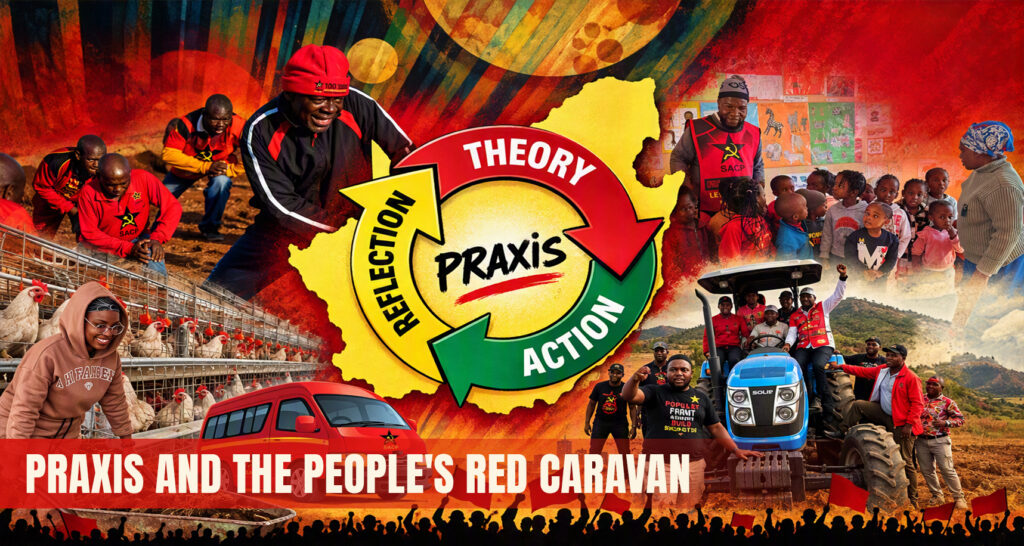
We call the answer praxis, the living unity of theory and practice. This overview explains the concept through the thought of the Italian communist Antonio Gramsci, and then examines the SACP’s People’s Red Caravan (PRC) as a concrete, contemporary attempt to practise it.
The aim is not only to understand praxis but to use it. Party members should finish this briefing able to ask of any activity: does it deepen our understanding of reality, and does our understanding of reality guide what we do?
What is praxis?
Praxis is not simply “practice”, and it is not “theory applied”. The common error is to imagine two separate things, a body of ideas on one side and a set of activities on the other, with the task of connecting them afterwards. In that picture the intellectual thinks, the activist acts, and a bridge is built between them.
Marx’s answer was different. In the Theses on Feuerbach he insisted that the point is not merely to interpret the world but to change it, and that the truth of thought is proved in practice. Theory emerges from the effort to transform reality, and transforming reality requires theory that grasps it correctly. Each is the condition of the other.
Two failures follow from separating them:
- Theory without practice becomes dogma, academic commentary, or a catalogue of correct positions that nobody acts on. Some might argue that the communist parties often speak beautifully about the working class while remaining absent from its life.
- Practice without theory becomes activism, charity, or project management: busy but with no strategic direction and no capacity to build power.
Praxis is the discipline of refusing both.
Gramsci and the idea of praxis
Gramsci wrote his Prison Notebooks under fascist censorship, and he called Marxism the “philosophy of praxis”, because the phrase captured something essential. For him Marxism was not a finished system to be recited. It was a living conception of the world, tested and developed in the struggles of the exploited.
Gramsci rejected the idea that philosophy belongs to specialists. Everyone, he argued, already holds a conception of the world, absorbed through language, religion, folklore and what he called common sense. In a related passage on intellectuals, he put it simply: “All men are intellectuals.” (This was the language of the day, referring to women and men collectively) What differs is not the capacity to think but the social function of thinking.
This has a profound implication for political education. We do not bring consciousness to empty vessels. We engage people who already think, whose understanding is shaped by experience, and whose ideas are contradictory.
Contradictory consciousness
Gramsci observed that the working person often carries what he called “contradictory consciousness”. On one side, is an understanding implicit in daily practical activity, which in reality unites a worker with fellow workers in transforming the world. On the other, is an inherited, official worldview, absorbed from ruling-class institutions, which can pull the worker towards passivity or resignation.
The task of the philosophy of praxis, he argued, is not to leave people in their common sense but to lead them to a higher conception of life. That ascent happens through collective practice reflected upon critically, not through lectures alone.
The organic intellectual
Every social class, Gramsci argued, creates its own layer of intellectuals who give it awareness of its function in economic, social and political life. Revolutionary organic intellectuals are not detached commentators. Writing about the new type of intellectual, he said their way of being could no longer rest on eloquence but on “active participation in practical life”, as “constructor, organiser, ‘permanent persuader’”.
This is a demanding standard. The communist cadre is neither a lecturer nor a functionary. She is an organiser who builds, a builder who explains, and a persuader who is present every day.
Hegemony as an educational relationship
Gramsci’s most influential idea is hegemony: the capacity of a class to lead society through consent as well as coercion, by shaping common sense. The ruling class does this through schools, media, religion and everyday institutions. A subordinate class must therefore build its own counter-hegemony, patiently, in civil society, before and while contesting for state power.
He was explicit about what this requires: “Every relationship of ‘hegemony’ is necessarily an educational relationship.” Counter-hegemony is therefore not a slogan campaign. It is a long process of collective learning, organisation and the building of new institutions and habits.
The Party as the organism of the collective
Finally, Gramsci described the revolutionary party as the organism in which a collective will begins to take concrete form. Its task is to unify scattered experiences into a coherent will, to educate its members and its class, and to turn local struggles into a common project. A party that merely observes, or issues instructions from above, cannot play this role. It must be embedded in the lives of those it seeks to lead.
The People’s Red Caravan as a method of mass work
The draft on which this revision builds draws on Tebogo Phadu’s Jack Simons Political School presentation of 24 May 2026. It presents the PRC as a renewed communist method of mass work, reconnecting Party organisation with the daily struggles of workers and the poor.
Its political purpose is to connect practical responses to people’s needs with organisation, critical understanding and collective action. Agricultural production, community stores and other initiatives are important sites of this work. Their revolutionary significance must be developed through the relationships and capacities they build.
Begin with the conditions of everyday life
The crisis of social reproduction concerns the conditions through which people sustain and renew life: food, shelter, water, health, care, income and the time required to secure them. Unemployment, inadequate public services and insecure livelihoods place pressure on households and communities.
Concrete investigation should establish how these pressures are experienced and distributed. Who owns or controls land? How do households obtain food? Who carries unpaid care work? Which suppliers determine prices? What public infrastructure exists, and who can access it? Which organisations already command participation and trust?
The Know and Act in Your Neighbourhood approach joins investigation to intervention. Knowledge should be developed with residents, discussed collectively and revised as action reveals new conditions. Mapping an unused site is one step; negotiating access, examining water availability and organising production reveal further social and institutional relationships.
Organise people as protagonists
Participants must have meaningful influence over priorities, decisions and evaluation. Access to useful goods or services is a real gain, but democratic participation requires opportunities to question leaders, obtain information and change decisions.
A community-owned store can become a place of political learning when members examine pricing, supplier power, working conditions and the use of surplus. A production initiative can develop collective capacities through decisions about labour, land, water and distribution. These educational possibilities require deliberate organisation.
Production, circulation, income, food security and democratic ownership are connected strategic concerns. Movement between them is not automatic. Transparent accounts, fair remuneration, collective planning and political discussion help turn practical connections into a shared project.
Co operatives as a conscious movement-building process
Co-operative development should be understood as the deliberate construction of a movement across villages and townships. Individual buying clubs, household producers, productive co-operatives and community-owned stores can be connected through networked forms of democratic organisation.
Shared procurement, aggregation, storage, transport, distribution and training can create practical relationships between communities. Producers can plan with buying clubs and stores; members can compare suppliers and costs; experienced organisers can support new structures. These links must be developed around actual capacity and need rather than an administrative blueprint imposed everywhere.
Economic coordination can provide a material basis for solidarity. It can reduce isolation, pool resources and strengthen bargaining power. Political education, exchanges between communities and joint campaigns can then help participants recognise common conditions and formulate shared demands.
A movement needs accountable representative structures as well as trading relationships. Local organisations should mandate delegates, receive reports and retain meaningful control over decisions affecting their members. Wider structures need clear responsibilities, transparent finances and procedures for resolving disputes. Coordination must expand collective capacity without concentrating knowledge and authority in an unaccountable centre.
Connecting local action to a wider programme
Consider an illustrative network linking household food producers in several villages with buying clubs and stores in neighbouring townships. Participants investigate supply, prices and household needs together. They test collection arrangements, discuss quality and payment, and review whether both producers and consumers benefit.
Through this work they may identify common obstacles such as unreliable water, expensive transport or inadequate storage. A collective response can combine changes within the network with organised demands for public infrastructure and support. The practical experience then informs political education about ownership, markets and public responsibility.
Such links do not make every participant a socialist automatically. Their political direction must be developed through discussion, organisation and struggle. A network becomes a movement when participants acquire the capacity to act together around a shared programme and to hold their own institutions accountable.
Co operatives within capitalist relations
Co-operatives operate within markets shaped by concentrated ownership, finance and unequal access to resources. They may face pressure to survive through unpaid labour, inadequate remuneration or exclusion of households unable to contribute. Collective ownership within an enterprise does not remove these pressures.
In his Inaugural Address of the International Working Men’s Association, Marx recognised the significance of co-operative labour while arguing that isolated co-operative efforts could not, on their own, emancipate the working class: “however, excellent in principle and however useful in practice, co-operative labour, if kept within the narrow circle of the casual efforts of private workmen, will never be able to arrest the growth in geometrical progression of monopoly, to free the masses, nor even to perceptibly lighten the burden of their miseries”.
Marx connected their wider development to the struggle for political power.
For the PRC, the implication is to link co-operative development with broader organisation around public provision, land, finance, infrastructure and economic transformation. Networks can improve bargaining capacity, but cannot simply escape capitalist relations by becoming larger.
The movement should examine who benefits, who bears costs and whether its practices strengthen solidarity. Financial viability matters because sustained losses undermine livelihoods and confidence. It must be pursued alongside decent work, democratic control and social purpose.
Women youth and the organisation of care
Recognising women’s contribution must lead to changes in how work, resources and authority are distributed. Women’s unpaid labour should not become the hidden subsidy that sustains community initiatives.
Branches and participating organisations should examine time spent on childcare, cooking, water collection and care for sick or older people. Meeting arrangements, transport, workloads and access to resources should enable participation. Men must share responsibilities, and women must exercise real authority over decisions and assets.
Young people’s participation also requires material consideration. Skills, remuneration, transport, access to equipment and meaningful decision-making matter alongside political and cultural work. Agriculture, logistics, processing, retail and digital systems can offer opportunities, but participation cannot rest on indefinite unpaid work or the assumption that unemployed youth are idle.
The same approach should identify barriers faced by people with disabilities and other excluded residents. Democratic organisation is strengthened when those affected help define the changes required for participation.
Community organisation the Party and the state
Street committees, co-operatives, buying clubs and community forums can contribute to people’s power when they have a real constituency, democratic mandates and the capacity to act. Their names or formal existence do not establish this character.
Party leadership should help develop political understanding and collective initiative while respecting the democratic governance of participating organisations. People who are not Party members must be able to participate meaningfully. Access to services and economic opportunities must not depend on political affiliation.
Community initiative must strengthen demands on the democratic state. It should not normalise failing public provision or transfer public responsibilities onto unpaid residents. A production project facing water shortages should help organise demands for reliable infrastructure as well as address immediate practical needs.
Public investment, accountable administration and democratic planning are therefore part of the same struggle. Community organisations can contribute knowledge, monitor commitments and mobilise around public priorities. State support should expand democratic capacity rather than create patronage or dependence on particular officials.
The National Democratic Revolution and socialism
The PRC should connect local work to the National Democratic Revolution and the struggle for socialism. The direction and outcomes of democratic transformation are contested through class struggle. Its emancipatory potential depends on the organisation, leadership and programme of workers and the poor.
Local improvements can build confidence and capacity, but cannot substitute for changes in ownership, public institutions and the wider organisation of production. Co-operatives and community stores are not socialism in themselves. They can contribute to socialist advance when connected to a wider movement capable of confronting capitalist power.
Democratic planning, collective ownership and solidarity must be learned and practised. These capacities can develop through struggles in the present, while their full realisation requires broader structural transformation. The relationship between immediate gains and the socialist objective must remain a subject of political education and strategic review.
The branch as a site of praxis
A branch can exist formally while remaining weakly connected to everyday struggles. The PRC should help test and deepen that connection. Its work requires ongoing organisation rather than occasional visits or launches.
District and wider coordination can provide training, shared systems and connections between local initiatives. This support should strengthen branch capacities and community control. Where participation declines, the response should investigate material pressures, leadership practices and organisational weaknesses rather than blame residents.
A branch should build a regular cycle of collective investigation, agreed action, review and correction. Participants need to know what has been decided, who is responsible and when results will be discussed. Learning should travel between branches and inform wider Party strategy.
A practical review method
Begin by identifying the problem with those affected and examining its wider causes. Record existing resources, constraints and differences within the community. Agree on achievable action, responsibilities and the political questions to investigate.
After action, review both material outcomes and changes in organisation. Have livelihoods improved? Who participated or withdrew? Who controls information and resources? Has unpaid work increased? Are leaders accountable? Have links with other communities and public demands become stronger?
Record explanations for success and difficulty, including disagreements. Revise the approach and return to action. This makes reflection part of organising rather than a report written only for external audiences.
A shared method can improve coordination, but must leave room for local adaptation and criticism. Common reporting and operating standards are useful when they support democratic decisions and learning. They should not reduce the movement to compliance with procedures.
Questions for collective discussion
1. What would distinguish revolutionary praxis from simply running a successful project in our area?
2. What have participants taught our branch, and which assumptions or methods have we changed as a result?
3. Who decides, who performs unpaid work and who benefits in our initiatives?
4. How could our buying clubs, producers and stores connect with others across villages and townships, and what democratic structures would those links require?
5. Which common obstacles could become the basis for joint campaigns and demands on the state?
6. How can we reduce women’s unpaid burdens and enable meaningful participation by young people and people with disabilities?
7. What pressures from capitalist markets are shaping our choices, and how can wider organisation help us confront them?
8. How will we review our next action and carry its lessons into branch education and wider strategy?